








Although second-hand fashion has become a global phenomenon, the patterns of adoption and growth vary significantly across regions. The US, the UK and continental Europe together account for the majority of the global resale market, but each is evolving in its own way, shaped by local culture, consumer behaviour and policy.
United Kingdom: cultural mainstreaming and digital acceleration
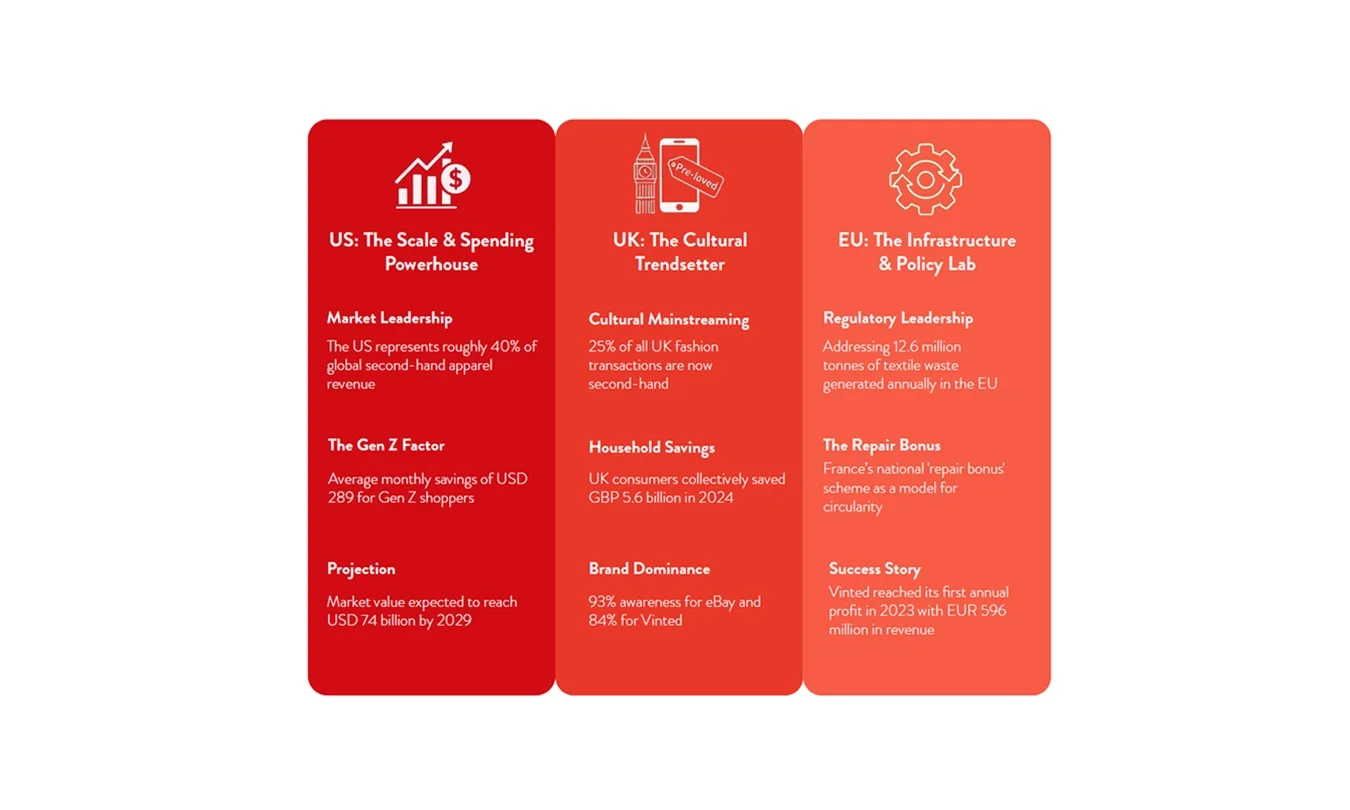
The UK has a deep-rooted culture of reuse, with charity shops long established on high streets and a vibrant vintage fashion scene. This cultural foundation has made it one of the fastest adopters of resale in Europe. Around 25% of all fashion transactions in the UK are now second-hand, and the overall resale sector is valued at more than GBP 7 billion. Forecasts suggest it will account for around 10% of total UK fashion spending by 2029, growing at about 9% per year and faster than the UK retail market as a whole.
Digital platforms have accelerated this growth, with eBay emerging as the most well-known second-hand apparel site in the UK (93% of respondents were aware of the brand), followed by Etsy (84%), Vinted (84%), ASOS Marketplace (54%) and Depop (47%), which was founded in London. London itself is a hub for preloved fashion, accounting for 25% of national second-hand apparel activity.
Affordability is a key driver of this expansion. In 2024, UK consumers collectively saved GBP 5.6 billion by buying second-hand and kept nearly 199 million items in circulation. Among younger shoppers, adoption is especially pronounced: 74% of consumers under 35 purchased second-hand in the past year, compared to just over half of those aged 55 and above. This generational gap underscores how second-hand fashion is becoming the default choice for younger demographics, who are motivated by both value and the appeal of unique vintage style.
Retailers are increasingly responding. Chains such as River Island have partnered with resale platforms to extend product lifecycles, while brands like Levi’s and Patagonia operate in-store resale and repair programmes. Policymakers are also now advancing circular infrastructure. WRAP’s ACT UK pilot, which ran between 2023 and 2025, has demonstrated that coordinated textile collection trials can increase volumes by up to 46% when households receive clear sorting instructions. It also evaluated the potential for a standalone automated textile sorting and preprocessing (ATSP) facility with the capacity to process around 25,000 tonnes of worn-out textiles annually. While only one facility model has been assessed so far, it offers a potential blueprint for scaling nationally, suggesting how future infrastructure could underpin a circular textiles system in the UK.
With high consumer acceptance and a supportive cultural backdrop, the UK market illustrates how resale can move quickly from niche to mainstream.
Together, the US, the UK and continental Europe show how second-hand fashion is evolving along different paths: scale and innovation in the US, cultural mainstreaming in the UK and infrastructure-led acceleration in continental Europe. Yet the destination is the same: resale is embedding itself as a structural part of fashion’s future. These regional variations highlight the diversity of the market and offer a preview of how other parts of the world may follow, adapting the second-hand model to their own cultural and policy landscapes.