







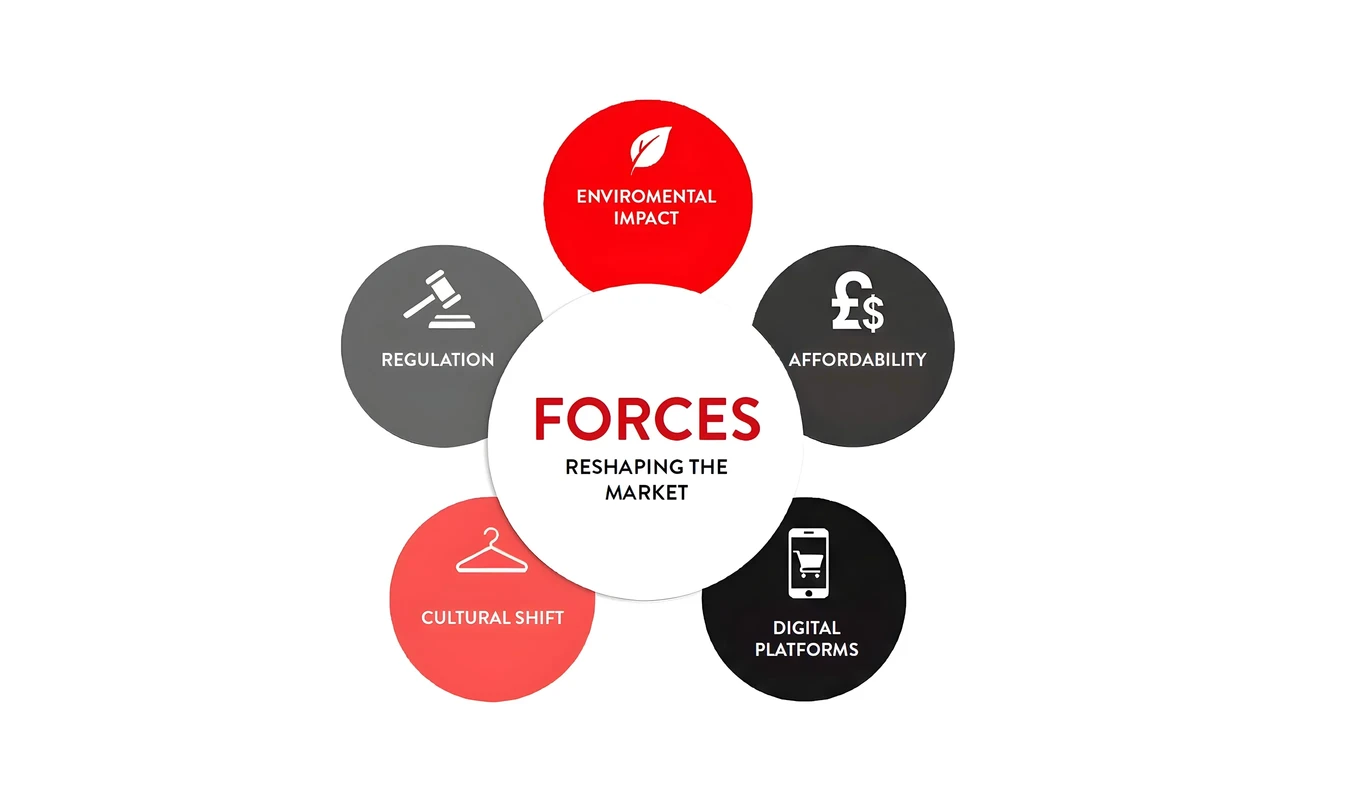
The remarkable expansion of the second-hand fashion market is not just a matter of numbers – it is being shaped by powerful cultural, economic, technological and regulatory currents. Understanding these drivers is crucial to appreciating why resale has become such a defining force in global fashion.
Environmental sustainability and circularity
Environmental awareness is one of the strongest underpinnings of resale’s growth. Life-cycle assessments suggest that when a second-hand purchase actually replaces the purchase of a new garment, associated emissions can be reduced by around 80% and climate impacts by several kilograms of CO₂ per item. 8 In practice, however, not every second-hand purchase is fully substitutive: recent studies put the displacement rate – the share of second-hand purchases that truly replace a new purchase rather than being bought in addition to it – at roughly 60% to 80% for fashion, implying that real-world savings are lower but still significant. Studies also show that, per use, choosing secondhand can cut climate impact by 42% and reduce energy demand by 42%, as well as result in 53% lower water scarcity footprint. These measurable benefits resonate especially with Gen Z and Millennials, who are highly climate-conscious. Campaigns such as Love Island – a hugely popular dating reality show among younger audiences – partnering with eBay in the UK, which triggered a 7,000% spike in searches for secondhand fashion on the platform,11 highlight how sustainability is moving into the cultural mainstream. Second-hand is no longer a compromise. Instead, it is becoming an aspirational expression of climate responsibility.
Affordability and value-seeking behaviour
Affordability is another central pillar of second-hand fashion’s popularity. Surveys show that 77% of Gen Z consumers in the UK cite affordability as a key advantage of secondhand fashion.12 At the same time, 62% of consumers worry that new tariffs could raise apparel prices, and nearly six in 10 say they would turn to more affordable options like second-hand if that happens.13 This financial logic runs alongside the appeal of ‘trading up’: resale allows many shoppers to access higher-quality or designer goods at a fraction of the original price, while sellers recoup value from items otherwise left idle. The result is a dual incentive system – save money and recover money – that reinforces second-hand items’ attractiveness during times of economic pressure.
Digital platforms and social commerce
While it’s clear that online resale has become the fastest-growing channel, the deeper story lies in how digital platforms are reshaping consumer behaviour and community. Marketplaces like Vinted, Depop and Poshmark have not only expanded access to millions of preloved garments but also turned resale into a highly social experience. For younger generations, these platforms are more than storefronts: they are communities where identity, creativity and sustainability intersect.
The integration of resale into social media is central to this shift. 39% of young shoppers bought second-hand apparel via social commerce platforms in the past year, and 50% said they purchased second-hand in the past year specifically to create or share content online.14 In effect, resale has become a cultural currency, where thrift hauls and vintage finds carry social value far beyond the clothes themselves.
Technology is also smoothing the resale journey. Almost 48% of consumers report that AI-driven tools such as personalised recommendations or image search make second-hand shopping as easy as buying new.15 This tech-enabled convenience helps overcome barriers like inconsistent sizing or quality uncertainty, making resale a seamless part of the shopping mix.
Together, these dynamics explain why resale is not just about cheaper prices or sustainability. It has evolved into a digital-first ecosystem where commerce, content and community reinforce each other. For the newest generation of fashion consumers, buying preloved fashion online is as natural as scrolling a feed or posting a story. This cultural normalisation is therefore one of the strongest engines behind the sector’s growth.
From stigma to style: changing consumer mindsets
A cultural shift has transformed second-hand from stigmatised to stylish. In the UK, 25% of all fashion transactions are now second-hand,16 showing how entrenched resale has become in everyday wardrobes. Across the US, 48% of younger consumers now say second-hand is the first place they look when shopping for clothes.17 Consumers are drawn by the promise of uniqueness, individuality and authenticity that comes with preloved fashion – qualities often absent from mass-market fast fashion. Influencers and celebrities have reinforced this shift, making thrift hauls, vintage outfits and circular fashion part of the mainstream cultural script. What was once marginal is now aspirational: a badge of creativity, frugality and responsibility all at once.
Regulation as a growth driver
Finally, regulation is beginning to act as a structural driver of resale. The EU generates around 12.6 million tonnes of textile waste annually, yet only 22% is currently collected for reuse or recycling.18 To address this, the EU Strategy for Sustainable and Circular Textiles makes separate collection of textiles mandatory and requires fashion producers to finance take-back and recycling through Extended Producer Responsibility (EPR) schemes.19 France has gone further, banning the destruction of unsold goods and obliging brands to redirect inventory into resale or recycling channels.20 In the US, California passed its first textile EPR law in 2024 (SB 707), which will require producers to join a responsibility organisation and fund collection and recycling starting once regulations take effect, no earlier than 2028, with full compliance required by 2030.21 These measures embed circularity into law, turning resale and reuse from consumer choice into systemic obligation.
In sum, second-hand fashion is thriving because five forces are reinforcing each other: measurable environmental benefits, affordability during economic strain, the convenience and community of digital platforms, a cultural revaluation of preloved style, and regulation that is hardwiring circularity into fashion’s future. These drivers ensure that resale is not a passing fad but a durable and accelerating shift in how fashion is produced, consumed and valued.