








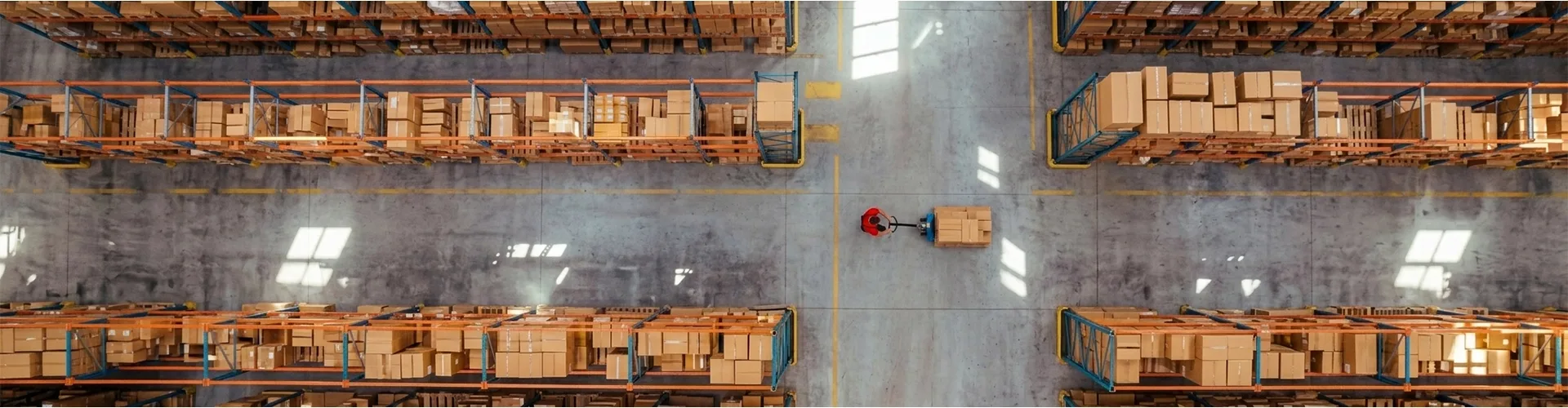
A complete range of warehousing services

Warehousing design & development
New warehouse design or the redesign of existing operations, tailored to your volumes, product characteristics, sales channels and future growth.

Order fulfilment
Complete order processing, including pick and pack, sorting, labelling, documentation and order tracking.

Inventory management
Receipt and storage of goods, with regular, seasonal and one-off inventory management to help maintain stock accuracy and availability.

Bonded Warehouse
Bonded warehousing services combined with import and export administration, helping simplify customs processes and keep goods moving efficiently.

Cross Dock Warehouse
Storage and transhipment solutions that help products move through the supply chain efficiently, supported by shipment tracking and operational visibility.

Deconsolidation & reconsolidation
We deconsolidate incoming shipments and reconsolidate goods as required, helping align product flows with your distribution and fulfilment needs.

A full grip on your inventory
For omnichannel brands, accurate inventory visibility is essential.
Bleckmann combines inventory management, reporting and a best-in-class Warehouse Management System (WMS) to give you greater control over stock across ecommerce, retail, marketplaces and wholesale channels.
Our WMS integrates with your wider technology ecosystem, helping improve stock accuracy, fulfilment visibility and operational efficiency.

First-time-right implementation
A successful logistics launch depends on getting every element right from the start.
Our proven implementation approach covers design, systems integration, testing and go-live, helping new operations launch smoothly, on time and within budget.
We have decades of experience and expertise in warehousing, further growing our capabilities and scope. We keep up with current developments in the industry while investing in new sites reflecting and anticipating our clients' business growth.
Lounge has every ambition of becoming that largest underwear brand in the world and see Bleckmann as an integral part in this journey.
Fulfilment centres where you need them
Bleckmann operates logistics sites across key markets including the Netherlands, Belgium, Spain, Germany, the United Kingdom and the United States.
Our strategically located facilities provide access to major ports, airports, road networks and consumer markets, supporting both local operations and international growth.


Some brands that already rely on us
















Frequently Asked Questions
Warehousing plays a crucial role in the supply chain and business operations for several reasons:
- Inventory Management: Warehouses provide a dedicated space to store goods, allowing businesses to manage and control their inventory efficiently.
- Order Fulfillment: Warehouses serve as distribution centers, ensuring that products are readily available for order fulfillment, reducing lead times, and meeting customer demands promptly.
- Risk Mitigation: By having a centralized location for storing goods, businesses can safeguard against disruptions in the supply chain, such as production delays or transportation issues.
- Cost Efficiency: Warehousing helps optimize transportation costs by consolidating goods in bulk, enabling economies of scale. It also facilitates cost-effective order picking and packing processes.
- Seasonal Demand: Warehousing allows businesses to store excess inventory during off-peak seasons and meet increased demand during peak seasons, avoiding shortages and maximizing sales opportunities.
Read for more detailed information about our sustainability framework, Read our Sustainability Journey Raport here
Warehousing involves storing goods in a controlled space before they are distributed, ensuring products are kept safe and readily available to be dispatched when needed. Whether companies are selling fashion items or lifestyle products, having access to reliable warehousing enables them to fulfil orders quickly, optimise inventory levels and reduce last-mile delivery times. For growing businesses, warehousing provides continuity, scalability and cost-efficiency, serving as a key pillar for ongoing operational success.
Yes, warehousing costs are often considered inventoriable, meaning they are included in the cost of goods sold (COGS). These costs include expenses related to storing, handling, and managing inventory within a warehouse. Examples of inventoriable warehousing costs may include storage space rent, utilities, security, insurance, and labor costs directly associated with handling inventory.
Inbound logistics involves the movement of materials or goods into your business – from suppliers or vendors to your warehouse. Outbound logistics, on the other hand, focuses on delivering finished products from your facilities to end customers or retailers. Reverse logistics (returns) is also part of inbound logistics. Effective coordination of inbound and outbound logistics is essential for smooth operations, cost control and timely deliveries.
Outbound logistics includes processes like order processing, packaging, transportation and last-mile delivery. When outbound logistics are optimised, customers receive their orders faster and in perfect condition. Poorly managed outbound logistics can lead to delays, damaged goods and increased returns. Businesses that invest in outbound logistics solutions, including real-time tracking and automated inventory management, can help prevent delays and damage and deliver a consistently outstanding customer experience.
Using integrated software or working with a logistics partner that manages inbound and outbound logistics together can greatly reduce coordination errors and increase fulfilment efficiency. Comprehensive, end-to-end solutions allow companies to track inventory at every stage of the supply chain, mitigating the risk of out-of-stock items and providing customers with real-time transparency on the whereabouts of their orders.
Real-time data in inbound and outbound logistics enables better decision-making and a smoother customer experience, enabling faster responses to disruptions or changes. It allows businesses to monitor shipments, track delivery times and quickly resolve issues. For instance, if an inbound shipment is delayed, companies can proactively adjust their inventory management system to avoid supply shortages. Similarly, real-time tracking in outbound logistics allows brands to provide customers with accurate delivery updates.
A warehouse management system (WMS) is a digital solution that controls inventory flow, tracks stock levels and streamlines pick-pack-ship workflows. A warehouse management system gives businesses real-time visibility into inventory, reduces manual errors and improves staff productivity. A WMS is particularly valuable for e-commerce and omnichannel retailers who require accurate order processing and fast shipping (from multiple warehouse locations), helping to meet customer expectations for fulfilment speed.
Inventory management in warehousing operations ensures that the right products are stored in the right quantities and locations to meet evolving market requirements. Effective warehouse inventory management prevents both overstocking and stockouts, even with fluctuating customer demand and a complex product assortment with thousands of SKUs. Technologies such as RFID and barcode systems enhance inventory accuracy by automating data capture, while integrated dashboards provide real-time insights into inventory turnover, supporting streamlined and effective replenishment planning.
Pallet racking is a storage system designed to hold goods stacked on pallets. It is designed to maximize vertical space and allow easy access with forklifts, making it an essential element for efficient warehouse operations. Logistics providers use pallet racking to optimize space utilization and organize inventory according to turnover rates and product characteristics. Tailoring racking solutions to product type and load capacity improves safety, speeds up warehouse operations, and promotes better inventory management.
RFID inventory management uses radio frequency identification (RFID) tags to track products throughout the warehouse. Unlike traditional barcodes, RFID systems enable bulk scanning without direct line of sight, significantly reducing check-in and check-out times. Using RFID technology for warehouse and inventory management ensures real-time data accuracy, improved stock visibility and enhanced theft prevention – making it particularly useful for high-value goods and complex fulfilment operations.
Get In Touch
Let's talk about the right-fit logistics solution for your business. Our experts are ready to help you.
