







Breaking down the barriers to system-level circular transformation in fashion
Although the need for increased circularity has become clear from many angles, the lack of a joined-up strategy hinders progress. The technology, infrastructure and systems required to support the scaling up of circular processes are advancing quickly, but the wider industry is demonstrably slower in taking up the baton. Addressing this mismatch requires a targeted analysis to reveal the often-invisible pain points faced by brands, partners and circular practitioners. As is often the case, the key ingredient is dialogue.
"Our work focuses on bringing linear and circular players together to develop sustainable business models for this post-consumer phase"
In this exclusive interview, Bianca Streng, Programme Manager for Textiles at Dutch sustainable business council Future Up (formerly MVO Nederland), reflects on what it truly takes to catalyse the fashion industry’s transition from intention to implementation. Her perspective is shaped by two decades in fashion design, entrepreneurship, and consulting. In her new role at Future Up, she is convening a one-of-a-kind industry advisory board focused on strategising and troubleshooting fashion’s circular transition.
Q: Bianca, you began your career as a fashion designer. What led you to broaden your focus to explore circular transformation at the system level?
I started out with a big dream: to design clothing for as many people as possible. And for a while, that worked just fine. After studying fashion design, I spent over a decade designing garments for several large retailers and brands here in the Netherlands. But over time, it became impossible to ignore the impact of the industry: the scale of production, the pressure on people in the value chain, and the environmental cost.
That realisation prompted a shift. I decided to move away from simply designing more products and towards a focus on redesigning the system itself. I founded a sustainable fashion brand, started my own circularity consultancy and wrote a book, Kledinghoop (‘Clothes pile’), detailing my view on the steps necessary for the industry’s sustainable transition. In 2023, I took on my current role at Future Up, where we’re committed to bringing the right stakeholders to the table to map out a collective path forwards.
Q: At Future Up, your work centres on post-consumer textiles. Why is this phase of the product lifecycle so critical?
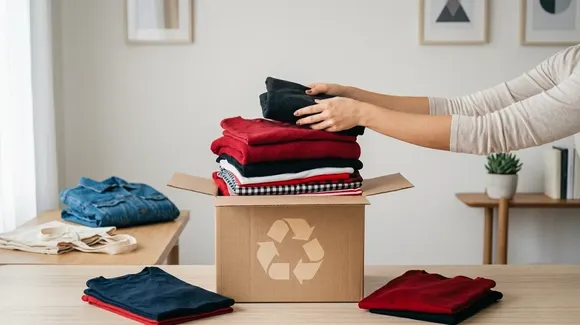
Of course, product design is key to extending product lifetimes. But if we want to accelerate change at scale, we also need to address what happens after the primary use phase. Today, enormous volumes of textiles reach the end of their first life with no viable second-life pathway. Our work focuses on bringing linear and circular players together to develop sustainable business models for this post-consumer phase – whether that’s repair, recommerce or recycling. The challenge is not a lack of ideas, but a lack of collaboration. Many companies are still working within traditional supply chains, while circular solutions often sit outside those structures. Our role is bridging that gap.
Q: Collaboration is obviously a key theme when it comes to accelerating circularity. What does an effective partnership look like in practice?
One of the most important insights is that brands do not need to own all circular infrastructure themselves to make a meaningful impact. In fact, it is often more effective not to. Brands and retailers already have strong capabilities – design, customer relationships, merchandising. Repair, resale logistics or textile recycling require a very different kind of expertise. When companies try to do everything internally, progress slows. When they partner with specialists, such as logistics providers, repair platforms and recommerce experts, circular models become viable much faster. At Future Up, our role is often that of a connector. We bring the right players together, facilitate knowledge sharing and help companies find partners they may not otherwise encounter.
Q: Policy is increasingly a major driver for brands across the spectrum. How do you see regulation influencing circular adoption?
Policy plays a crucial role in creating momentum, including for those companies for whom sustainability isn’t a first priority. For many years, frontrunners have recognised the need to become more sustainable, but voluntary action is not enough to drive systemic change. Instruments such as Extended Producer Responsibility, Right to Repair and the Ecodesign for Sustainable Products Regulation are now providing both greater clarity and urgency. However, regulation alone will not deliver transformation. What matters is how companies integrate these requirements into their strategy. Circularity needs to be embedded at the board level, not treated as a parallel or separate agenda.
Q: That integration sounds challenging. What are the main barriers you see within organisations?
One of the key challenges is translating sustainability ambition into strategic and financial language that resonates at the leadership level. Many organisations separate financial KPIs from sustainability targets, which makes it difficult to prioritise long-term circular investment. Data is critical here. When companies can demonstrate the financial, environmental and social impact of circular business models – supported by robust data – it becomes much easier to build internal alignment. This is why frameworks such as CSRD and ESRS, while complex, are ultimately powerful tools. They create a more complete risk picture, drive transparency and enable better strategic decisions. At Future Up, we’ve even developed a dedicated leadership programme designed to help directors and C-level management to integrate circularity in their company policy.
Q: It sounds like data is a key piece of the puzzle, then, but it can also be one of the most complex areas to manage. How can companies address this?
The challenge is not just collecting data, but aligning it across the value chain. Brands often request information from suppliers, only to find that data availability stops partway through the value chain. At the same time, suppliers may be asked for similar data in multiple formats by dozens of customers. We need shared infrastructure and common standards – from digital product passports to interoperable reporting systems. Initiatives working on global data standards are an important step, but success will depend on collaboration and mutual understanding. At the beginning of this year, we organised a meeting that brought together both textile and food companies to discuss supply chain transparency. The aim was to share three best practices from each sector, and what you saw was that people from the different sectors recognised each other’s challenges. There was also plenty of mutual inspiration, with solutions shared for transparency in different ESG areas – such as working conditions – as well as how to ensure interoperability across different suppliers and compliance platforms. The forum was a great demonstration of why the industry’s transparency efforts must be a shared journey.
Q: Communication around sustainability is becoming increasingly sensitive, with more robust regulatory action at the EU and at the country level. How should companies approach this?
Understandably, many companies in the fashion space have become more cautious about communicating the sustainability benefits of their products. The regulatory environment rightly means that all sustainability claims are coming under increased scrutiny, with a high bar for proving the merits of your products. For me, this links up quite nicely with the previous question, in that these proof points come from comprehensive and granular reporting. Therefore, in my view, the solution is not silence – or so-called green-hushing – but building credibility in the integrity of your reporting systems. In their communications, brands should remain grounded in data, transparent about progress and honest about challenges.
Q: You recently established a Textile Advisory Council within Future Up. What role does this play in the transition?
The advisory council exists to ensure that our textile programme is aligned with real market needs. It brings together companies from different parts of the value chain – including a major Dutch retailer, circular innovation scale-ups, workwear producers and infrastructure partners such as Bleckmann. The goal of this broad-based approach is to deliver solutions with long-term results by integrating firsthand strategic input from different industry players. Rather than working on assumptions, we test our direction with the practitioners who are going to be implementing the changes on the ground. This dialogue sharpens our focus and helps ensure that the solutions we develop are practical, scalable and relevant. What has emerged clearly from our conversations so far is that circular transformation does not begin with technology or targets but with a combination of leadership and collaboration. Progress depends on shared infrastructure, well-aligned incentives and a willingness to work together across traditional boundaries.
Q: Looking ahead, what gives you confidence about the future of circularity in fashion?
What excites me is that we’re seeing genuine movement on multiple fronts. A lot of that is being driven by policy, of course, but on top of that, many more brands are understanding the benefits in terms of waste reduction, lifespan extension and customer loyalty. Resale markets are growing faster than traditional retail. Repair and refurbishment services are becoming mainstream. It’s creating what might be described as a convergence in terms of the motivations of brands, customers and regulators. And while I believe that this convergence point is still some way off, we have a clear direction and tools and processes to get us there. Brands shouldn’t have to have all the expertise themselves, but they do need to be proactive in looking for and assessing the right partners. I think as more and more come to terms with the evolving industry landscape, we’ll see a large increase of circular service. We’ve got everything in place to advance to the next stage together, so it’s a very exciting time.
More information about Bianca’s work is available at https://www.biancastreng.nl/