






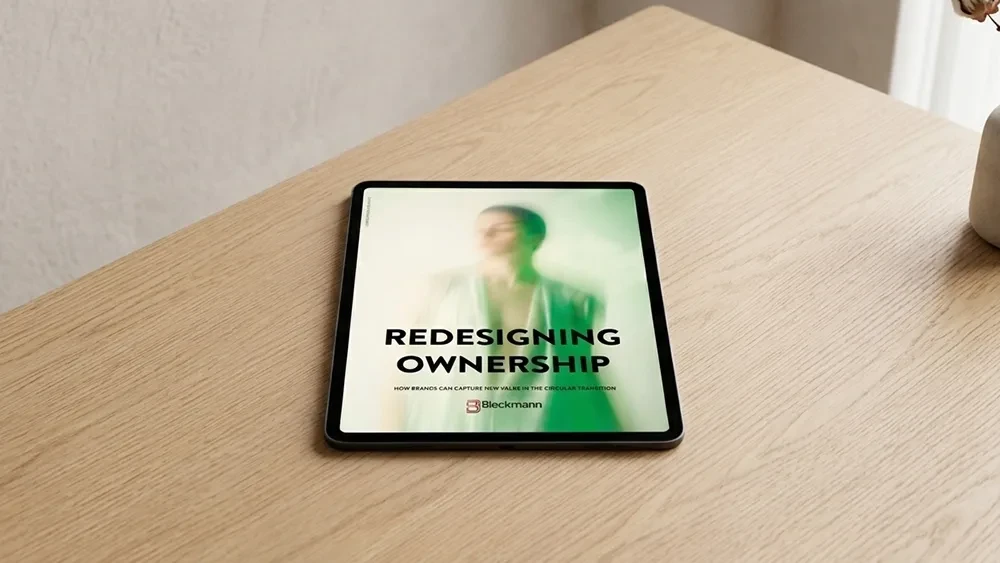
Welcome to Bleckmann’s 2025 Leading Circular report. This report began nearly half a decade ago, and over that time, we’ve seen a fashion industry coming to terms with the new reality: from the stratospheric growth of online resale (which was in what we now know to be an early growth phase in 2020) to the (admittedly slow) progress of fashion sustainability legislation through the European regulatory machine. But as we present our fifth edition of the report, we’re faced with a fashion circularity space that has grown in both maturity and complexity. Many of our clients have been proactive in recognising this, and we’re proud to support them in delivering solutions that support their sustainability strategies – driven by both environmental and economic considerations.
Circularity is where environment and economics converge
Indeed, in many ways, the past year has proved that circularity is where environment and economics converge in fashion. Hit by the increasing cost of living around the world, more and more shoppers are turning to pre-loved fashion as a way of economising. Meanwhile, a rising tide of regulation in Europe is providing a strong push factor for brands to adopt or further integrate circular business models. This somewhat unlikely crossover means that investing in circularity provides fashion players with a unique opportunity: capitalise on consumer demand for circular fashion while strengthening regulatory preparedness ahead of fast-approaching compliance deadlines. So, what’s the catch?
For one thing, many other actors are also active in the space. Well-established fashion resale marketplaces such as Vinted, ThredUp, and Depop – alongside luxury-focused platforms such as Vestiaire Collective and TheRealReal – already have huge user bases. With sophisticated analytics and sleek UI, they are capturing an increasing proportion of shoppers’ “circular mindshare”. This means that brands looking to enter or expand in this more mature market need to think beyond isolated initiatives such as capsule collections or take-back schemes. They need to understand where circularity fits into the priorities of today’s customer and build well-integrated solutions that reflect this new paradigm.
Underpinning this shift we’ve seen in the past few years is what seems like a reappraisal of ownership in fashion. On the one hand, the sheer volume of clothing currently owned – and often underused – remains a major driver of fashion’s environmental footprint. On the other hand, ownership is beginning to take on a new, more constructive meaning. The evolving social, economic, and environmental imperatives discussed are pushing brands and value chain actors to take greater ownership of their social and environmental impacts. In this way, ownership becomes the solution rather than the problem: a pathway to more intentional, responsible stewardship of garments across their full life cycle.
This is slowly and steadily creating a new value equation – one in which the moment of purchase represents the beginning of a garment’s value-creation journey, not its culmination. Transparency and accountability are becoming foundational to every stakeholder relationship, including with customers. The companies that will thrive in this landscape will be those that recognise the long-term value embedded in circular practices: value that sits not just in sustainability credentials, but in customer loyalty, brand differentiation, and operational resilience. In this report, we go behind the headline stats to explore what this changing landscape means for brands living the transition.
Whether it’s how different circular approaches can address evolving consumption trends or which models can help to meet European regulatory obligations, we’re asking the questions that count. We’ll also discuss the new face of transparency in fashion, driven by frontrunner countries like France, with its comprehensive Ecobalyse carbon labelling initiative for clothing. We also spoke with circular consultant, podcaster, entrepreneur, and design coach Bianca Streng about the challenges of putting circular models into action for brands large and small. Finally, we take a look at what fashion and lifestyle brands across categories can learn from the still-booming industry of sneaker resale.
To make a very long story very short, leading in circularity is no longer a question of brand differentiation. The stakes are far higher. It’s also about enabling a more valuable value chain. Delivering true circular value means navigating the transition from three critical vantage points: that of the customer, that of the brand, and that of the service partner. We’re already seeing how our clients are translating fast-moving regulation and evolving consumer sentiment into practical strategies across design, sourcing, logistics, communications, and data management through the power of partnership. Because when everyone in the value chain takes – and shares – greater ownership, we can all act decisively rather than reactively and move with confidence toward a more circular future.
Hans Robben — Program Manager, The Renewal Workshop