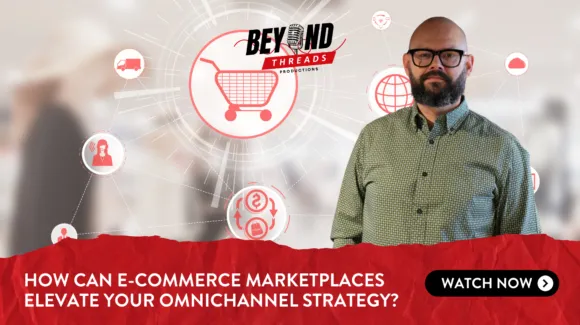








In this Beyond Threads webinar logistics expert Sebastiaan van Setten van der Meer offers valuable insights into omnichannel logistics – an increasingly crucial strategy for fashion brands operating in today’s fast-paced retail environment.

This video is unavailable because marketing cookies have not been accepted. Click here to update your cookie preferences.
What is omnichannel fulfilment?
Omnichannel fulfilment simply means the integration of all sales channels – physical stores, e-commerce sites, mobile apps, social media and online marketplaces – into a single, unified logistics system. This approach enables fashion brands to offer customers a seamless, consistent experience, regardless of how or where they choose to shop.
Unlike traditional logistics models, where each channel is managed in isolation, omnichannel fulfilment enables full coordination and visibility across the supply chain. In short, by connecting all sales channels through a centralised logistics strategy, omnichannel fulfilment delivers tangible value across the entire retail operation.
Listen To Audio Only
Key benefits of omnichannel fulfilment
One of the most compelling advantages of adopting an omnichannel fulfilment strategy is an improved customer experience. Today’s shoppers expect convenience, speed and reliability – and omnichannel fulfilment enables brands to deliver just that across all platforms. Whether a customer purchases online and collects in-store, or returns a product via a third-party drop-off point, this level of flexibility can significantly improve customer satisfaction and drive long-term loyalty.
Beyond customer-facing benefits, omnichannel fulfilment can also improve operational efficiency. By centralising inventory and integrating fulfilment systems, brands can streamline their logistics operations, reduce errors and gain real-time visibility across channels. This integration also enhances agility, allowing companies to respond more effectively to fluctuations in demand or shifts in consumer behaviour.
Another major benefit is cost reduction. Consolidating both B2B and B2C operations within a single logistics framework enables businesses to share infrastructure, lower transportation costs and minimise challenges such as overstocking or stockouts. Strategic placement of fulfilment centres can further reduce last-mile delivery costs while improving delivery times.
This means omnichannel fulfilment creates a unified logistics ecosystem that supports better decision-making, operational excellence and customer satisfaction – making it a vital strategy for retailers looking to stay competitive in an increasingly dynamic market.
Overcoming the challenges of omnichannel fulfilment
While the benefits of omnichannel fulfillment are clear, implementing a successful strategy requires careful planning, the right technology and a unified vision. Managing real-time inventory across multiple platforms can be complex without integrated systems and accurate data. In addition, maintaining a consistent brand experience across diverse channels requires close coordination and a clearly defined customer experience strategy.
Technology plays a central role in addressing these challenges. Robust warehouse and order management systems (WMS and OMS), along with flexible fulfilment models – such as buy-online-pick-up-in-store (BOPIS) or in-store returns for online orders – can help brands remain agile and responsive.
Ultimately, the shift to omni channel fulfilment isn't just a logistical upgrade; it’s a strategic move that empowers retailers to meet evolving customer expectations, operate more efficiently and position themselves for long-term growth. As the retail landscape continues to evolve, those who invest in integrated, customer-centric fulfilment models will be best placed to lead.
Want to learn more about how you can overcome the challenges of omnichannel fulfilment? Press play on our Beyond Thread webinar to get the full story!
__________________________________________________________________________________________________________________
Transcript
Hello everybody and welcome to this new episode of Beyond Threads webinar. My name is Sebastiaan van Setten van der Meer and I’m going to walk you through the omni-channel logistics of today.
Omni-channel logistics is more than just a buzzword. Omni-channel logistics is a vital strategy that supports how you engage with your customers, how you optimize your processes, and it is a way to stay competitive in today’s markets. In this webinar, titled Introduction to Omni-Channel Logistics, I will walk you through what omni-channel logistics is, where it came from, and what the benefits are of leveraging omni-channel logistics within your market strategy for your brand.
We will also go through some challenges and considerations you may face when utilizing an omni-channel logistics strategy in your business case. Whether you are just starting your omni-channel logistics approach or refining an existing one, this webinar will guide you through the fundamentals and the impact omni-channel logistics can have on your brand.
[Music]
To start things off, I want to show you how retail commerce evolved into a multi-channel strategy. Initially, retail started with a single channel. Typically, a company had one physical store in a city where products were sold directly to customers.
With the introduction of the internet, new possibilities emerged, such as online webshops. This added a new channel through which customers could purchase products, whether via laptop or mobile phone. With this multi-channel solution, customer experience evolved, as customers could now buy products both in-store and online.
However, this raised new questions. For example, if a customer bought a product online, could they return it to a physical store? This led to the development of cross-channel retail, where customers could interact with a brand through different channels while still experiencing it as one single entity or brand.
Later on, even more channels were introduced, such as large marketplaces with extensive reach. Brands could connect to these platforms and sell their products there as well. Social media then became another important channel, used to promote brands through influencers and integrated webshops. All of this resulted in the omni-channel approach as we know it today.
This evolution created many logistical challenges. Let’s take a look at how these market changes affected logistics.
[Music]
To understand this, let’s go back to 1862 when Benjamin Blackman founded the company. At that time, logistics mainly involved transporting goods from the warehouse to retail stores. There was also a manufacturing stage before that, where products were produced and moved toward the warehouse. Logistics back then was fairly straightforward: trucks were loaded and sent to stores to replenish inventory.
With the rise of online sales, logistics changed drastically. Instead of shipping boxes with multiple items to one store, companies had to ship single products to residential addresses. This required different packaging materials, multiple carriers, faster lead times, and the ability to handle returns efficiently.
Warehouse service providers had to adapt to these new requirements. Maintaining stock visibility became more complex. For example, if a customer returned an online purchase to a physical store, the company needed to register the return, assess its condition, and decide whether it could be sold as new or not.
Logistics providers also had to collect returns from stores and grade returned inventory. Internal logistics processes were divided into B2B and B2C streams. B2B involved shipping pallets or large parcels to businesses, while B2C focused on picking individual units, packing them for consumers, and managing different return flows.
With omni-channel logistics, both streams still exist, but multiple sales channels must be managed simultaneously. This increases the need for advanced inventory management and real-time visibility. Companies must understand which inventory belongs to which channel and anticipate different return volumes.
Selling through marketplaces adds further complexity. Inventory may be stored externally, and companies must meet marketplace-specific requirements. External stock levels must be monitored, and replenishment must be coordinated. Additionally, last-mile delivery options such as home delivery, pickup points, and drop-off locations must be supported, along with flexible return solutions to meet customer expectations.
[Music]
In short, omni-channel logistics is an approach that supports doing business across multiple sales channels. It acts as a support mechanism for the brand.
So what are the benefits of managing everything under one roof? In many cases, B2B and B2C operations are handled at separate locations. With omni-channel logistics, these operations can be combined.
This setup increases scalability and flexibility. B2B operations deliver to distribution centers, retail stores, and external partners, while B2C operations support marketplaces, social media platforms, and brand-owned webshops. Centralized inventory management allows companies to minimize stock levels while remaining flexible. If one channel overperforms, inventory can be shifted from other channels to meet demand.
Omni-channel logistics also enables expansion into global marketplaces, allowing brands to sell internationally with greater ease. Fulfillment costs can be reduced by consolidating personnel and inventory in one location and by strategically choosing warehouse locations to reduce last-mile delivery costs.
Another key benefit is improved customer experience. Managing all logistics activities from one location ensures consistency, so customers receive the same service quality regardless of whether they purchase from a marketplace, social media platform, or webshop.
[Music]
When implementing or refining an omni-channel logistics strategy, several challenges must be considered. First, brands must define their customer experience vision. Understanding customer expectations and how the brand wants to be perceived guides all logistical decisions.
Maintaining consistent brand identity across channels can be difficult, as each channel has different requirements and expectations. A clear customer experience vision helps protect brand identity.
Centralizing inventory management is essential to achieve real-time visibility, scalability, flexibility, and cost efficiency. Choosing the right systems, such as warehouse management systems and order management systems, supports forecasting and operational control.
Fulfillment flexibility is also important. Omni-channel logistics typically supports online sales and store replenishment, but solutions like buy-online-pick-up-in-store can further improve inventory efficiency.
Partnering with the right third-party logistics provider can be highly beneficial. Experienced 3PL partners already support omni-channel strategies and offer established technology, connectivity, and scalable multi-user systems. These partnerships enable smoother scaling, both domestically and globally.
Finally, continuous data analysis is crucial. Businesses must monitor channel performance, focus on high-performing channels, and identify opportunities to replicate success across other channels.
[Music]
In conclusion, omni-channel logistics is a powerful driver of business growth while ensuring a consistent customer experience across all sales channels. Partnering with experienced logistics providers allows companies to manage complexity effectively while focusing on innovation and customer engagement. It also improves operational efficiency by combining multiple logistics operations into one integrated system.
Before closing today’s session on omni-channel logistics—the first in a series of three—I would like to thank you for joining. I hope this session was insightful and enjoyable. If you would like to continue the conversation, feel free to reach out via email, our corporate website, or LinkedIn.
Thank you. My name is Sebastiaan van Setten van der Meer, and this was Beyond Threads.
[Music]