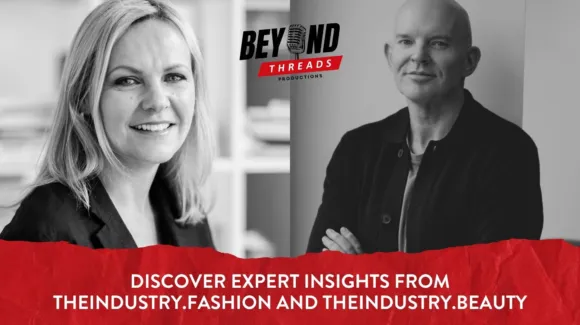









How can brands build loyalty and grow their audience amid constrained consumer spending? In part two of our Beyond Threads conversation with Lauretta Roberts and Anthony Hawman – co-founders of TheIndustry.fashion and TheIndustry.beauty – the focus turns to the strategies that help brands cut through. From high street names to digitally native challengers, the team examines how the strongest players are prioritising resilience, clarity of vision and creative conviction to drive growth in a tougher market.
Press play on the Beyond Threads podcast to get the full story, and click here if you missed part 1!

This video is unavailable because marketing cookies have not been accepted. Click here to update your cookie preferences.
Reinvention as a catalyst for growth
A central theme of the episode is brand reinvention – not as a reactive reset, but as a strategic lever for growth. The discussion explores how established retailers are regaining relevance by reassessing fundamentals such as product quality, design integrity, leadership and creative direction. Recent examples highlight how the brands gaining traction are those that invest in creativity at a moment when caution is tempting.
Founder-led brands are highlighted as particularly effective in this context. With long-term commitment and personal accountability built into decision-making, they’re often better placed to protect creative conviction and resist dilution as they scale. For the industry more broadly, the message is clear: reinvention works when it reconnects a business to its original point of difference and is executed consistently across product, partnerships and customer experience – with creative and commercial discipline.
Listen To Audio Only
Technology with a human touch
While creativity is undoubtedly a key strategic driver, another part of the equation is technology. Indeed, as an enabler of better brand experiences rather than a solution in itself, the most effective uses of technology can support more satisfying brand interactions and storytelling. Physical retail remains key. Stores are discussed as spaces that build visibility, trust and emotional connection. When combined with thoughtful use of technology – from frictionless returns to flexible checkout options – physical environments can deliver both greater efficiency and depth of experience. A key takeaway is the importance of balance: customers expect speed and convenience, but also value moments of personal service and advice. Retailers that understand when to prioritise each are better positioned to meet rising expectations without eroding brand equity.
Advice for the next generation of brands
As the conversation turns to emerging brands, the emphasis shifts to execution. Resilience in a constrained market is framed as a result of strategic focus, clear differentiation and operational discipline. The discussion highlights the importance of building from a strong core proposition, rather than pursuing multiple growth levers at once, with a distinctive product, genuine expertise and a brand experience customers return to. Expansion strategies such as international growth, live shopping and physical retail are positioned as valuable additional accelerators, but only effective when supported by the right partners and infrastructure. In short, sustainable growth comes from doing fewer things well, at the right time, without diluting strategic direction.
Why brands should be optimistic about the future of fashion
While there’s no denying the pressures being faced across the industry, Lauretta and Anthony highlight meaningful opportunities for brands willing to take a disciplined, long-term view – enabling considered decision-making about their brand, product and customer experience. Above all, the conversation reinforces the importance of clarity – in positioning, execution and leadership. For brands that approach growth with focus and intent, aligning expansion with a strong core proposition, today’s market conditions present not just a challenge, but the potential for more resilient, sustainable growth.
Press play on part two of the Beyond Threads podcast to hear the full conversation and gain further insights into how creativity, leadership and retail experience are shaping the future of fashion!
Transcript
Erik Janssen Steenberg: Hi there, and welcome back to the Beyond Threads podcast by Bleckmann. I’m your host, Erik Janssen Steenberg, and I’m still joined by Anthony Hawman and Lauretta Roberts, founders of TheIndustry.fashion and TheIndustry.beauty.
We’re looking into what makes the fashion industry so cutting edge, from technology and changing consumer behavior to legislation and everything else that is shaping the sector.
We left off after a good number of questions, but I have a big one for you.
You both know what is happening in the market. You know the sector inside out.
What is one surprising insight, or perhaps a particular brand story, that has really stood out to you over the past few weeks or months?
Lauretta Roberts: I’ll go first.
I don’t think you can have a podcast about fashion retail in the UK market, which is where we are, without talking about Marks & Spencer.
Erik Janssen Steenberg: Surprising, but a good one.
Lauretta Roberts: It’s a brand that has always been loved, but until a couple of years ago it was really struggling, particularly on the fashion side.
It had lost its way. It had become a little dull.
Every now and then there would be a few strong products, but overall it was struggling.
Then they brought in new leadership, including Archie Norman and Stuart Machin, and they completely shook up the fashion side of the business.
They now have Maddy Evans leading womenswear, for example, and they carried out a complete root-and-branch reinvention of the fashion offer.
Babywear, kidswear, sportswear, menswear, womenswear, lingerie—you name it.
Nothing was left unexamined.
They looked at quality, design, colors, brand ambassadors, partnerships—everything.
And they turned the fashion business around.
That’s like changing the direction of a steamship. It’s a huge operation.
And they did it at a time when the market was in a downturn, with all the post-pandemic trauma still affecting retail.
Yet they delivered such a compelling fashion offer, and it was selling across the board.
It was such a joy to see.
Their food business has always been outstanding, but their fashion had not been.
I was full of admiration because, while so many competitors were struggling or disappearing, Marks & Spencer managed to turn itself around.
And I genuinely hope Stuart Machin stays there for a while longer.
I almost want him to run the country afterwards.
Obviously, they’ve also had to deal with serious challenges recently, including a malicious cyberattack that disrupted their online business for a significant period.
It was unbelievable.
But even after that, the company announced further investment in its stores.
They just keep going.
It was a nightmare, and not every company could cope with that sort of disruption and financial impact.
But it feels as though they’ve compartmentalized it.
They dealt with that crisis, but they haven’t allowed it to stop the rest of the business.
They’re still creating strong fashion partnerships.
They’re still investing in stores.
They haven’t let it derail them.
And I think that’s incredibly important because, amid all the difficult news in retail, they are one of our flagship brands.
Erik Janssen Steenberg: To me, it sounds as though they rediscovered their love for the product.
Lauretta Roberts: Totally.
That’s why I’m so enthusiastic about it.
They should be an inspiration.
Obviously, we can’t all be that big, but we can all have that attitude.
If more companies did, I think the industry would be in a better place.
Anthony Hawman: I agree.
There were so many brands in that same sort of cohort that unfortunately aren’t around anymore.
At one point, it was genuinely worrying.
People were thinking, “Please, M&S, don’t disappear.”
And they’ve really turned it around.
It used to be considered a bit uncool.
People would say, “I buy my underwear and food at M&S, and that’s about it.”
Now people are saying, “Have you seen what M&S has got?”
The menswear is great.
The womenswear is great.
The beauty offer is incredible.
And I know we’re not here to talk about food, but I’d probably be a lot thinner if M&S food didn’t exist.
It’s also just a great story for British retail.
It’s fantastic to see that they’ve weathered the storm because it is genuinely very difficult out there.
Every day, we’re reporting on companies making redundancies or closing stores.
It’s heartbreaking.
And yet M&S is weathering that storm.
Good luck to them. I hope they keep doing it.
Lauretta Roberts: And another surprising development, which I think we touched on in part one of this podcast, is the return of the physical retail store.
I don’t think everybody expected that.
For a long time, people assumed we would eventually be shopping almost entirely online.
But online still represents only part of UK retail.
I thought the percentage would be higher by now.
In some ways, I’m glad it isn’t, because we need a healthy high street.
Our high streets were really damaged after the pandemic, and some areas are still struggling.
But we’re starting to see some really interesting retailers opening stores again, including new businesses.
That has been a positive surprise.
Erik Janssen Steenberg: I see something similar with Superdry.
The founder and former CEO returned to the helm and started turning the ship around.
You’re also seeing that reinvention on the high street and a return to what the brand originally stood for.
Lauretta Roberts: I think that’s a really interesting example.
It can be a double-edged sword, but sometimes a founder leaves a company, perhaps not entirely by choice, and then fights their way back in.
Sometimes it takes that person who has the real passion, the real knowledge, and the genuine connection with the brand to make that difference.
Superdry is a great example of that.
Erik Janssen Steenberg: That passion is very visible.
You see companies such as M&S and Superdry starting to radiate that passion again.
They want to engage the customer and make the customer happy.
I think that was missing for a long time.
Anthony Hawman: Yes.
You see it time and again.
A brand reaches a certain size, the founder cashes out or moves on, and somehow the company loses something.
Sometimes it eventually disappears.
That happens in beauty as well.
Lauretta Roberts: We should also talk about luxury.
Everybody has been talking about how consumers are buying less luxury, and there’s been so much movement between designers at the major houses.
It has felt like musical chairs.
Then Jonathan Anderson came out with his first show for Dior Men, and it was incredible.
It was exciting.
For a while, luxury had started to feel a little flat.
All the news was, “Nobody is buying luxury anymore.”
And then suddenly you see something genuinely creative and exciting again.
It made the whole sector feel more buoyant.
Fashion hasn’t felt that way for quite some time.
So it was good news.
Anthony Hawman: I think the key word is creativity.
And passion, as you said, Erik.
Marks & Spencer put creativity and passion back into its fashion offer.
And, funnily enough, it paid off.
When times are difficult, it’s very easy to cut creativity.
It’s easy to cut quality.
It’s easy to play safe.
But that can be the worst thing you do because it gives the customer nothing to get excited about.
The same applies to luxury.
Some of those major brands had become stale.
Prices just kept increasing every season.
You find yourself thinking, “Really? Seven or eight thousand pounds for a handbag?”
For that price, it had better be something very special.
But then sometimes it feels like essentially the same handbag they tried to sell you last season, only more expensive.
Even if you have all the money in the world, that can become an unattractive proposition.
Something needed to change.
And it’s interesting to see designers moving between houses.
Jonathan Anderson is a hero for me.
He did an incredible job in his previous role, turning a house into something culturally relevant and powerful within fashion.
It appealed to people from Gen Z through to Gen X and beyond.
It wasn’t targeting one age group.
It was about people who appreciated great design and culture.
I was hoping he would move to Dior because I love Dior.
And what he delivered for menswear really made me excited about fashion again.
That is what really good fashion should do.
Lauretta Roberts: I can’t wait to see what happens next at some of these major houses.
I’m probably far too excited about all of it.
I won’t necessarily be able to afford the clothes, sadly, but I’m very interested to see what happens creatively.
Erik Janssen Steenberg: Lock up the Amex.
Lauretta Roberts: Exactly.
Erik Janssen Steenberg: So maybe I already know part of the answer, but for people who are building a brand or a fashion business in today’s climate, what is one non-obvious piece of advice you would give them?
Lauretta Roberts: My first question would always be: do you genuinely love it, and do you really want to do it?
Someone once put it to me like this: “Would it kill you not to start that business?”
And I completely understand what that means.
When you’re a founder, yes, you have freedom.
But at the same time, you are also completely tied to the business.
It is incredibly hard work.
It can be emotionally draining.
At the beginning, you have to be so many different things.
Even when you reach a certain size, you’re still wearing lots of different hats.
People always give the usual advice, such as “hire people who are better than you.”
And that’s good advice.
But before that, you really need to ask yourself: am I genuinely prepared to do this?
Because it isn’t all the fun stuff, like sitting here doing this podcast.
This is fun.
Tomorrow, we might be sitting on the floor packing goodie bags for an event.
That’s the reality.
So if you’re doing it because you think it will all be glamorous and wonderful and you can do whatever you want, that probably isn’t the right reason.
You really need to ask yourself whether you want it badly enough.
Anthony Hawman: And unless you’re prepared to give up a considerable amount of your life, it might not be worth it.
It is extremely hard work.
But if you are absolutely determined to do it, then work out what you are brilliant at.
Work out what you can do differently.
And focus very, very strongly on that.
Try not to be too many things at once.
It’s very difficult to launch a huge ready-to-wear collection and instantly gain credibility across all of it.
It may be better to find one thing you can do exceptionally well.
It could be something as simple as cotton shirts.
Everybody needs shirts.
People may buy more than one.
And that’s another important point.
Try not to launch a business around something a customer will only buy once and then never need again.
Customer acquisition is one of the hardest parts of building a business.
Imagine you create a beautiful £1,000 trench coat.
People may absolutely love it.
But if they only need one and don’t come back for another ten years, that creates a very difficult business model.
So think about whether customers can purchase from you again, without encouraging unsustainable consumption.
Then slowly expand from your initial area of expertise.
If you become known for excellent shirts, perhaps you can move into pajamas or other adjacent categories.
You can expand credibly.
Customers understand the connection.
Find the one thing you believe you can do really, really well and focus on it at the beginning.
Lauretta Roberts: Exactly.
It might be knitwear.
It might be footwear.
Just remember that you don’t want a business where somebody buys one thing once and is finished with you forever.
That’s a very difficult model.
Erik Janssen Steenberg: When you give that answer, I imagine there must be one or two entrepreneurs or founders who immediately come to mind—people others can look up to or relate to.
Anthony Hawman: Yes.
A few come to mind.
I’ll mention one of your clients, not because I’m trying to promote you, but because Gymshark is an incredible example.
It isn’t necessarily a brand I personally aspire to wear, but from a business perspective, what they built is remarkable.
They found one thing they could do really well.
Gymwear.
Proper training apparel for people who were genuinely into working out and lifting weights.
Then they slowly expanded.
They built a community around it.
They built an experience and a culture around the brand.
And it grew incredibly quickly.
I don’t know Ben Francis personally, but I really admire the way he conducts himself.
He’s still so young, and it’s obvious that he has given his heart, body, and soul to the business.
He deserves the success he’s had.
I really admire founders who understand exactly what they’re trying to do and are uncompromising about it.
Erik Janssen Steenberg: And they clearly bring their heart to the table.
Anthony Hawman: Completely.
Lauretta Roberts: I’m obsessed with listening to founder podcasts.
Partly because I’m always trying to work out whether I’m doing it right myself.
There are so many beauty founders I admire as well.
People like Caroline Hirons, for example.
She has built a brand, an agency, a podcast, live events—so many different things.
Then there are founders such as Colette and Mark from The INKEY List.
There are so many incredible people.
The thing they all seem to have, which I wish I had more of, is almost uncontrollable energy.
I’m sure they go home at the end of the day and sit in a dark room to decompress.
But publicly, they always seem to be moving forward.
It may be like a duck: everything looks calm above the water while underneath they’re paddling like mad.
But they have this attitude of, “Give me more. I can take this on.”
I really admire that.
There are so many brilliant people doing great things.
I could probably give you a very long list.
They inspire me in what we do because there are days when running a business genuinely feels like too much.
Anthony Hawman: And this other person sitting next to me inspires me too, as cheesy as that sounds.
I had to say it.
Lauretta Roberts: I know.
And actually, we are lucky.
One of the positive things about being entrepreneurs and founders is that you can choose who you work with.
We get to work with good people.
Bleckmann is a prime example.
You’ve been very supportive of us.
When you build your own company, it becomes very personal.
So when great clients have confidence in you and support what you do, it’s very rewarding.
You work with some very large businesses, and receiving that kind of support makes the hard work feel worthwhile.
Erik Janssen Steenberg: Lastly, as something of a bonus for the audience, what new growth opportunities do you think emerging brands should explore?
What could really help propel them forward?
Lauretta Roberts: There are lots of possibilities.
I’ve been talking a lot about physical retail, but I also quite enjoy seeing brands move into areas such as live shopping.
I think that can be a great opportunity for brands that have strong stories and charismatic founders.
They can sell products within a live shopping environment, or use ambassadors who can communicate the product story.
I think that’s very interesting.
International growth is another opportunity.
Even if you’re relatively small, you can still find a willing audience in other markets if you have the right people and infrastructure behind you.
So I wouldn’t want brands to be too afraid of international growth.
After Brexit, international expansion felt frightening for UK brands.
Then you have things like tariffs and all the uncertainty around global trade, and it can feel impossible.
But you may be surprised.
I’m a consumer in the UK, and I discover tiny Scandinavian brands or small French brands that I become obsessed with and buy from.
If I’m doing that here, there will be consumers in those markets willing to do the same with British brands.
So don’t only think about your own island or your own little area of Europe.
Think beyond those borders.
There is an audience out there.
And if you can open a store, physical retail can really help propel a brand to another level.
If a permanent store is too much, perhaps consider pop-ups in different locations.
Physical retail can support both your store sales and your online sales.
And apparently, you also need a matcha bar.
If you have a matcha bar, apparently you’ve made it.
Anthony Hawman: If I see one more matcha, I think I’m going to lose my mind.
It’s everywhere.
Clearly, that’s where all the money is.
Lauretta Roberts: And those giant cookies.
Matcha and giant cookies.
Put those in the store and everybody will come.
We sound ancient now, saying, “All the kids are drinking matcha and eating cookies.”
Erik Janssen Steenberg: I know the feeling.
Lauretta Roberts: But seriously, I have children, and one of them is starting to become a shopper.
Let me tell you what they don’t like.
They hate trying things on.
They hate standing in queues for a long time.
They don’t like too much choice.
And they don’t want to be bored while they’re in the store.
So make it really clear what you offer.
Why should they come into the shop?
Give them interesting things to do while they’re there.
Have a very clear proposition.
“This is what we sell.”
Then you may have a winning formula.
They do want to shop.
But if they arrive and think, “Oh no, I have to stand in a queue, and then another queue to check out,” they lose patience.
And why shouldn’t they?
It isn’t a very enjoyable experience.
Anthony Hawman: We had exactly that experience recently.
We went into a shop and the queue went all the way around the store.
We just walked straight back out.
We weren’t prepared to wait.
Then you compare that with a retailer like Zara in central London.
I recently had a return.
A member of staff immediately said, “Don’t queue. Go over there, scan it, take a bag, put the item in, attach the label, drop it into the return point.”
And I was done.
That’s a very different experience.
Lauretta Roberts: And that connects to the technology discussion we had in the first half of this two-part podcast.
The best uses of technology are where humans and technology work together.
Never forget the human element of a store.
Sometimes customers do want to speak to somebody.
They may have a question.
They may want someone behind a counter.
They may want that interaction.
But sometimes they don’t want any of it.
Sometimes they simply want to get in and out as quickly as possible.
We went into another store recently because I wanted to buy a pair of shorts for my daughter before catching a train.
I wasn’t willing to stand in a checkout queue for 20 minutes.
If they had offered a simple self-checkout option, I would have picked up the shorts, paid, and left.
Instead, they lost a sale.
For every person willing to stand in a long queue, there may be many more who simply walk out.
So don’t forget the checkout experience, and don’t forget the human side either.
Erik Janssen Steenberg: Don’t forget who your customers are.
Lauretta Roberts: Absolutely.
Erik Janssen Steenberg: Thank you both for those valuable insights.
In my opinion, this has been an incredibly interesting and fun conversation.
Thank you for sharing your knowledge and expertise.
Unfortunately, we do need to wrap things up.
I’m sure our listeners and audience have enjoyed the conversation just as much as I have, but they may still have questions.
How can people reach you if they want to continue the conversation?
Lauretta Roberts: They can follow us on our social media channels.
We’re on LinkedIn and Instagram through TheIndustry.fashion and TheIndustry.beauty.
They can also visit our websites.
All of our content is free to access, so there are lots of insights available there.
They can sign up for our daily newsletter.
And people are always welcome to connect with us on LinkedIn if they have questions.
We’re very open, so they can absolutely reach out.
Erik Janssen Steenberg: You certainly are.
As I said, I would have loved to continue this conversation, but we’ve reached the end of the episode.
To our audience: make sure you subscribe to the Beyond Threads podcast and follow Bleckmann on our social media channels.
That way, you can stay up to date with the latest trends and innovations in fashion and lifestyle logistics.
I hope to see you again soon for our next episode of Beyond Threads.
Until then, see you soon.