








A ban on the destruction of unsold goods would mean an operational overhaul for many brands. But that’s exactly what the European Commission has introduced with the adoption of the Ecodesign for Sustainable Products Regulation (ESPR).1 2 Add to this the growing consumer scrutiny of linear ‘take-make-dispose’ practices, and it becomes clear that a solution is needed to address fashion’s well-documented returns problem.
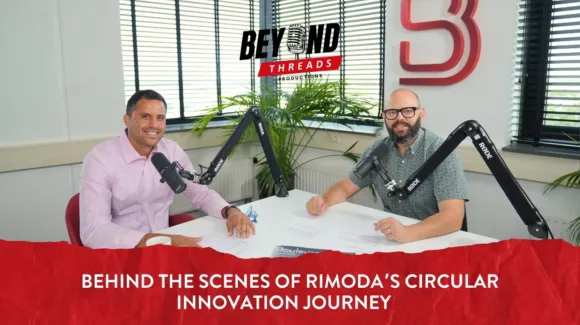
That’s exactly what Rimoda, an innovative circular fashion start-up based in the Hague, the Netherlands, proposes to do. In the latest episode of the Beyond Threads podcast, host Erik Janssen Steenberg talks to Ribal Mahdi, founder of Rimoda. Together, they discuss how the young company’s AI-enabled marketplace is transforming fashion waste into new value while creating shared benefits for brands, consumers, and society.
Press play on the Beyond Threads podcast to learn how circular fashion start-up Rimoda is addressing the industry’s returns problem, supported by Bleckmann’s Bscale!

This video is unavailable because marketing cookies have not been accepted. Click here to update your cookie preferences.
A practical pathway to sustainability success
Rimoda represents a fresh perspective on circularity in fashion, challenging conventional approaches. As Ribal explains, “Most multinational organisations are too big and too slow to actually adopt circular business models that are scalable enough to create the desired change. There was a need for bottom-up approaches through innovation.”
Rimoda achieves this through two key methodology shifts. The first is its dual-sourcing approach, in which brands can sell returned items to Rimoda directly, and shoppers can also sell their unwanted garments. The second is its AI-supported triage system. Shoppers simply upload images of the garments they want to sell to the platform, and the AI system automatically identifies attributes like type, colour, brand and fabric. This allows the Rimoda to offer immediate discounts or value for these unwanted items.
Future-proofing fashion through shared value creation
Rimoda’s model demonstrates how impact-first, for-profit business models can drive genuine transformation in the circular fashion space. “I want to prove that impact and profit can go hand in hand, and that actually, with the right approaches, we can transform fashion waste into wealth,” Ribal concludes. “Successful circularity must connect consumers, brand and society. When we are able to create shared value among these three stakeholders, we can then create a circular, closed-loop model.”
In short, Rimoda is offering a practical pathway for brands looking to implement circular models and for customers looking to participate in the circular economy. Its partnership with Bleckmann’s Bscale solution has also been key to scaling this ambitious and disruptive vision. By providing a plug-and-play access to enterprise-grade fulfilment, last-mile and warehousing solutions, we’re supporting the company in its objective of ensuring that circularity in fashion creates more value for everyone involved.
Press play on the Beyond Threads podcast to learn more about Rimoda’s journey towards creating a more accessible and value-adding circular marketplace. And stay tuned for the next episode to find out more about how it’s implementing its high-tech solution!
Transcript
Erik Janssen Steenberg: Welcome to another episode of the Beyond Threads podcast by Bleckmann. As promised in part one, this is part two.
As always, I’m your host, Erik Janssen Steenberg, and I’m still here with Ribal Mahdi, founder of Rimoda, one of the newest kids on the block in the Netherlands.
Thank you for being here, my friend.
Ribal Mahdi: It’s always a pleasure to be here. Nice to see you.
Erik Janssen Steenberg: I can imagine, because part one went very well.
So let’s make sure we maintain that high standard for part two, where we want to show what Bleckmann and Rimoda have done together to form a partnership that is ready for growth, ready for success, and ready for a more circular—truly circular—approach to second-hand, or as you sometimes call it, unwanted clothing.
For the listeners who missed the first episode, could you briefly introduce yourself again?
Ribal Mahdi: Yes. My name is Ribal Mahdi, and I’m the founder of Rimoda, an AI-enabled circular marketplace for unwanted fashion based in The Hague.
Erik Janssen Steenberg: AI—the buzzword.
Can you explain a little more about where AI comes into your processes and how it assists you, the consumer, and also the brands?
Ribal Mahdi: Absolutely.
We leverage AI to identify the different attributes of the clothes customers upload.
Customers take pictures of clothing they no longer want, and through AI we can identify different attributes of those items, such as the type of item, the color, the brand, the fabric, and so on.
Based on that information, we can offer them immediate value for those clothes.
Erik Janssen Steenberg: So the AI system essentially helps connect all the relevant information and determine the value of what is available?
Ribal Mahdi: Exactly.
AI allows us to offer customers immediate value for their unwanted clothes based on the attributes of those garments.
They upload pictures of the clothes they no longer want and immediately receive a valuation.
Erik Janssen Steenberg: There you go. That’s even better.
So that makes it a very straightforward proposition for the consumer.
You clearly identified a need—first a niche, and now something that can grow into a full-scale service.
What trends and developments in circular fashion have you observed over the years and especially right now?
Ribal Mahdi: If we look at the current trends in circular fashion, we can group them into three different categories.
The first is circular production or manufacturing.
The second is circular design.
And the third is circular business models.
The majority of current activity is happening in circular production and circular design.
There are some great innovations in those areas that are helping accelerate progress.
We’re talking, for example, about recycling materials and reusing those materials in future production.
But if we look at the Ellen MacArthur Foundation’s work on circular innovation, we see that only a relatively small number of innovations fall into the category of circular business models.
That shows there is still a gap and a need for more innovation in circular business models within the fashion industry.
Erik Janssen Steenberg: That makes sense, but help me with one thing.
You mentioned an index from the Ellen MacArthur Foundation. What exactly does that tell us?
Ribal Mahdi: It brings together different examples of innovation within the fashion industry and categorizes them according to different areas, sectors, years, types of innovation, and so on.
It’s a very useful resource for understanding where circular innovation is taking place.
Erik Janssen Steenberg: Nice. Thank you for explaining that, because you lost me for a second there.
Based on that, what do you think needs to change in consumer behavior, but also perhaps in legislation and policy, to make the next push and bring circular fashion into the mainstream?
Ribal Mahdi: I think there is already a lot of positive policy development taking place.
We can refer to new EU waste policies, and also to Dutch targets and policies for fashion waste towards 2025 and 2030.
Those are good examples.
In my opinion, one thing that could accelerate adoption would be more incentives—for example, tax relief or other incentives for circular fashion business models.
Another area is consumer education.
That could start by embedding circularity into school curricula.
And there is something else I always think about when it comes to policy: governments should practice what they preach.
For example, I often wonder what governments do with military uniforms.
How are they sourced?
Are they sourced ethically?
And what happens to them after they are used?
Do governments encourage second-hand use, for example?
[A short section is missing from the source captions between approximately 6:40 and 6:58.]
Ribal Mahdi: That kind of action could also help encourage public adoption of circular policies.
Erik Janssen Steenberg: Absolutely.
That is very much a top-down approach.
As a company, Bleckmann is positioned more in the middle, so to speak.
And that’s one of the things that gets me out of bed in the morning.
I’m really proud of what Bleckmann is doing at the moment.
Without wanting to toot our own horn too much, I think we have the right action plan and the right priorities we are working on as a team.
And as a result, we get to work with interesting companies like Rimoda.
Can you explain what it means to you to be part of the Bscale environment within Bleckmann?
How has it helped you turn your idea into reality?
Ribal Mahdi: The Bscale solution is essentially a one-stop shop for everything related to logistics, warehousing, and even last-mile delivery.
As a start-up founder, it was imperative for me to work with the right partners.
I needed professional partners who could take responsibility for those areas while I focused on the start-up itself and on business development.
Bscale in particular was plug-and-play.
It was very easy to integrate with my e-commerce platform.
It’s easy to use and easy to access and understand the data.
And the team behind it has been very helpful.
They’re only an email or, when necessary, a phone call away.
Overall, I find it very useful, and I look forward to using it even more as we grow.
Erik Janssen Steenberg: Thank you for saying that, because that really hits the nail on the head.
When my colleagues and I looked at how Bscale should work, that was exactly the goal.
It should be something you can activate and then trust.
You know what is happening behind the scenes.
You know what the expected outcome is.
And you know you’re in good hands with the Bscale team.
So it’s very good to hear that.
Bscale is an important partner for Rimoda, but what role do partners in general play within Rimoda’s plans?
How are they—and how are we—going to help you accelerate and grow?
Ribal Mahdi: As start-up founders, it is important to understand that innovation is only one part of the journey.
The innovation phase is exciting.
You have a great idea, then perhaps an MVP, and the early stages can feel very positive.
But after that, you always have to think about the transition from innovation to competitiveness.
To achieve that, you need the right partners.
And that is where a partner like Bscale fits very well.
They can support and accompany us during our scaling journey.
For an e-commerce platform, we depend heavily on reliable fulfillment and supply-chain partners.
That reliability is essential.
Erik Janssen Steenberg: Exactly.
That was the objective of Bscale.
You come to us with a good idea and with your specific needs.
We bring our expertise and experience.
Then, when we team up, we can support the fluctuations you experience—whether in customer interest, sales, or operational volumes.
We have your back because we’ve handled those fluctuations many times before.
We can scale up and down alongside the actual demand.
Ribal Mahdi: Exactly.
It’s also very important, when choosing partners, to choose companies that can scale with you when you are ready to scale, but at the same time act as a safety net when things go wrong.
We’ve seen how the supply-chain world can be affected by sudden tariffs, for example, or by something as disruptive as a pandemic.
Things can move in any direction.
That can significantly affect any innovation or start-up.
If you are not working with the right partners, those shocks can become a major problem.
Erik Janssen Steenberg: Exactly.
A partner needs to be complementary.
They need to give you the opportunity to feel unburdened so that you can remain focused on your core business.
I tell brands this all the time.
You didn’t wake up one morning and decide to enter fashion and lifestyle because you wanted to become an expert in supply-chain management and logistics.
Logistics is simply one of the complexities that comes with success.
We know how to manage that complexity and turn it to your advantage.
That’s very good advice, but I know you have more.
What other advice would you give start-ups in fashion, and particularly those working in circular fashion?
Ribal Mahdi: The main advice I would give aspiring circular-fashion start-ups is this: when choosing your partners, don’t choose them based on where you are today.
Choose them based on where you want to be in five years.
That way of thinking is very important because the ultimate objective of most start-ups is to scale.
If you choose partners who are ready to join you on that scaling journey and who have the expertise and experience to support that growth, you are more likely to succeed.
I would also advise founders to do proper research before approaching companies.
Personally, I had an assumption that working with a global organization like Bleckmann might be more expensive.
But once I did my research and spoke with different people within the company, I found that the pricing was very competitive and the value was strong.
So I would always advise founders to do their own research.
There is another important aspect as well.
As start-up founders, one of our objectives is often to find financing and secure investment.
Choosing the right partners and working with established, reputable global companies can influence how potential investors assess your business.
For example, if your supply-chain partner is Bleckmann, investors know that the logistics and supply-chain side of the business is supported by an experienced partner.
That removes one potential concern for them.
Erik Janssen Steenberg: Good to hear.
And besides being your friendly presenter, I’m also a Business Development Manager at Bleckmann, so I talk with a lot of brands.
When they compare our pricing with a competitor or with doing everything in-house, sometimes a potential customer will tell me: “You’re too expensive.”
My answer is always: “Wait a minute. Have you looked at what you are actually getting for that price?”
If you are only looking for pick, pack, and ship, then no, I know we may not always be the cheapest.
We’re not necessarily the most expensive either, but we may not be the lowest-cost option.
But if what you’re looking for is to be unburdened and supported by an experienced partner that helps guide you, then the overall cost compared with the value you receive is very different.
Again, without trying to toot Bleckmann’s horn too much—and thank you for helping me do that during this episode—I think we are in a very strong position to help brands like yours move from the emerging stage to a steady state, then into growth, and eventually into an established business.
A lot of people know Bleckmann for our partnerships with large, globally recognized brands.
But a very significant part of our portfolio is made up of medium-sized companies all the way down to emerging businesses.
So thank you for sharing that perspective.
And again, thank you very much for being here.
It has been a very good conversation.
I enjoy talking about the value of Bleckmann and our services, but I also like discussing the strategic side.
You touched on something important: we are not only connected operationally; we are also aligned strategically.
Ribal Mahdi: Exactly.
We are aligned on the vision, and that is very important.
Erik Janssen Steenberg: Exactly.
Even when my answer to you is “no,” you’re interested in understanding why.
Otherwise, my “yes” won’t mean very much in the long run.
Thank you very much for being here today, my friend.
As always, how can people reach you if they have questions, if they want to know more about what you’ve just discussed, or if they simply want to talk about what Rimoda can offer them?
Ribal Mahdi: They can feel free to reach out to me through LinkedIn. My name is Ribal Mahdi.
They can also visit Rimoda at www.rimoda.nl.
Erik Janssen Steenberg: Great.
And with that, we close part two.
I hope—and I trust—that you’ve learned a lot about Rimoda, about Ribal and his journey so far, and about Bscale and Bleckmann.
I hope to see you again soon in the next episode of the Beyond Threads podcast by Bleckmann.
Until then, I’m Erik Janssen Steenberg. Talk soon.