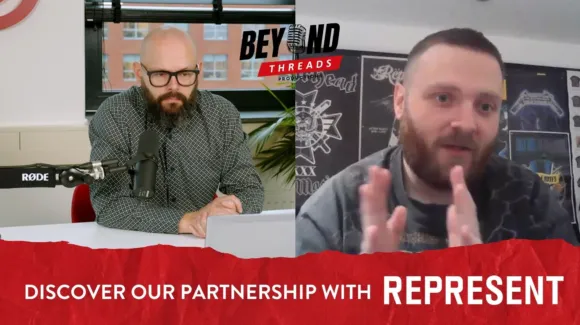








In the latest episode of the Beyond Threads podcast, host Erik Janssen-Steenberg sits down with Lauretta Roberts and Anthony Hawman, co-founders of TheIndustry.fashion and TheIndustry.beauty – B2B news and insight platforms helping brands and retailers to navigate the shifting retail landscape. In the first part of our discussion, they explore how innovation, technology and changing consumer behaviour are redefining the fashion and beauty landscape – from the return of physical retail to the rise of circular business models, the growing role of AI technology and what really influences trends today.
Press play on the Beyond Threads podcast to uncover a wealth of expert perspectives!

This video is unavailable because marketing cookies have not been accepted. Click here to update your cookie preferences.
Beyond digital-first: Understanding the experiential (r)evolution
A central theme is the evolving role of physical retail. After years of rapid e-commerce growth, there’s been a renewed shift towards stores, particularly among Gen Z and younger millennial consumers. Rather than a move away from digital, Anthony and Lauretta describe a more nuanced evolution. Physical retail is becoming increasingly experience-led, with stores doubling as social spaces, cafés and community hubs.
Shopping is no longer defined just by transactions, but by engagement, discovery and time spent with a brand. This shift is playing out across the market – from challenger brands opening thoughtfully designed flagship stores to established retailers investing in loyalty programmes, hospitality concepts and private members’ spaces. It signals a
Listen To Audio Only
Technology as an enabler across the value chain
If experience-led retail is reshaping how brands show up in the physical world, technology remains the connective tissue that enables these shifts at scale. It’sa consistent thread throughout the episode, from AI-driven customer communication and smarter personalisation to greater transparency across the supply chain. While the fashion and beauty sectors have long been early adopters of digital innovation, the team acknowledges the growing complexity brands now face, as the number of tools, platforms and data sources continues to expand. For logistics and supply chain professionals in particular, technology is increasingly expected to support not just efficiency, but also trust, clear communication and streamlined regulatory compliance.
Navigating visibility in a crowded market
The episode also takes a closer look at the challenges facing emerging and scale-up brands. While digital channels have lowered the barrier to entry, they have also created an intensely crowded marketplace. Standing out, building a loyal audience and managing rising marketing costs remain persistent concerns. The experts explore how brands are responding – from leveraging strategic retail partnerships to building stronger narratives through owned channels. The conversation underlines the importance of credibility, consistency and long-term thinking in a media landscape shaped by algorithms, influencers and rapidly shifting trends.
Within this context, the discussion also touches on the growing prominence of circular models. Resale platforms, vintage fashion and peer-to-peer marketplaces are becoming increasingly mainstream, particularly among younger consumers – driven by a combination of environmental awareness, economic pressures and changing attitudes to ownership. For brands, this can represent both opportunity and challenge, requiring new thinking around product design, data, traceability and lifecycle management.
Grounded insight for a fast-moving industry
From changing consumer behaviour and evolving retail models to the growing influence of technology and sustainability, the fashion and beauty landscape is being reshaped – and TheIndustry.fashion and TheIndustry.beauty are committed to translating these changes into practical insights for brands, retailers and their partners. From our discussion, the message is clear: success depends less on responding to individual trends, and more on understanding how the landscape is changing as a whole – and responding with clarity, consistency and long-term intent.
Press play on the full episode of the Beyond Threads podcast to get the whole story and gain deeper insights into the forces shaping the future of fashion and beauty. And check back soon for part two of our conversation!
Transcript
Eric: Welcome to another episode of the Beyond Threads podcast by Bleckmann. I’m your host, Eric, and as always, I’m thrilled to have you with us today.
In each episode of Beyond Threads, we take a deep dive into the topics shaping fashion and lifestyle logistics. Today, we’re exploring what makes the fashion industry so cutting-edge. We’ll look at how innovation, digital transformation and changes in consumer behaviour are driving change across fashion and beauty.
For that purpose, I’m joined today by Anthony Hawman and Lauretta Roberts, co-founders of TheIndustry.fashion and TheIndustry.beauty. They’ll guide us through what’s next for brands, retailers and the entire fashion ecosystem. Thank you both for joining us today.
Lauretta Roberts: Such a pleasure. Thank you for having us.
Anthony Hawman: It’s great to see you, Eric. Thanks for having us.
Eric: Thanks. Of course, we’ve been working together for quite some time now, and we’re practically friends. But for the audience, could you briefly introduce yourselves and TheIndustry, and, as a bonus, highlight the main trends you’re currently spotting in our sector?
Lauretta Roberts: I’ll kick off and tell you a bit about us. I’ll let Ant add some more, and then I’ll come back to those trends.
As you said, I’m Lauretta. I’m the co-founder of TheIndustry.fashion and TheIndustry.beauty. We’re a business-to-business platform for brands and retailers operating primarily in the UK retail market. We do have international retailers in our audience, but we write everything from a UK perspective.
And you are our friends. We’re not practically friends; we are good friends with you. We work very closely with you and have done for a number of years.
On a day-to-day basis, we deliver news and insights to our audience. That includes breaking news, interviews, opinion pieces, insights and data — everything we think they need to stay up to speed with what’s happening in their market.
We simply want to help them do a better job. There are a lot of challenges out there that they have to deal with, so through our content, we help them navigate those challenges.
On a less regular basis — not every day, thankfully — we stage events. These can be networking events or conference-style events. We host awards for both fashion and beauty, as well as smaller events such as roundtables for C-level executives in the industry and various other formats.
We’re very active and very close to our audience. We like to facilitate knowledge exchange and networking between them.
Ant, do you want to talk about how we collaborate with companies like Bleckmann?
Anthony Hawman: Of course. As Lauretta says, we really want to help our markets do better business. One of the best ways of doing that is by connecting them with great suppliers like you guys at Bleckmann, Eric.
We’re very mindful of how we do that because, ultimately, we want to help the market. We run dinners, conferences and forums. It’s all content-led because that’s what we do — it’s our bread and butter.
The main aim is to help the market and make sure people are as well informed as possible so they can do better business.
Lauretta Roberts: As for those trends, there’s a lot to talk about, and I’m sure we’ll get into more detail as we move through the podcast.
I’ve actually been sitting here today writing about the market, and I learn something every day. One of the things that has particularly struck me, especially in the UK market and when looking at the younger generation of shoppers we’re all trying to attract and understand, is this shift back towards physical retail.
We’re not quite where we might want to be yet, but I’ve been quite surprised that Gen Z and the younger end of the millennial cohort actually like going to shops.
During the pandemic, which was probably around the time we first started working with you guys, it was all about the boom in e-commerce. E-commerce is still strong and still growing, but it has definitely levelled off, and we’re starting to see a return to stores.
Here in the UK, we’re seeing quite a lot of store openings. We lost many legacy retailers; some disappeared from the high street altogether. Some survived as digital-only brands, while others disappeared completely.
But now we’re starting to see some really interesting challenger brands, whether they’re UK brands or international brands. Particularly in London, brands are coming in and opening very beautiful stores.
That’s a trend I’m quite excited and interested in. Ant, you had an observation when we were talking the other day about something that struck you as well.
Anthony Hawman: Yes. I think you’re absolutely right. People want experiences again.
Of course, e-commerce is efficient. You can have things delivered to your home and all of that is great. But there are now lots of brands creating cafés within their stores, and shopping almost becomes secondary. It’s more like: come and have a matcha, come and have an iced coffee, or whatever it may be.
It’s really about engaging with the audience. And I think you’re right that a lot of this is about Gen Z and younger consumers, but even I enjoy going into those places and seeing what they’re doing.
It’s an engagement tool to bring people in.
Lauretta Roberts: It’s an activity again, isn’t it? It isn’t purely transactional.
And actually, we’re seeing it with older consumers as well. Let’s face it, neither of us is Gen Z by any stretch.
Only last week, I was writing about Selfridges opening a private members’ club. That’s not necessarily going to be aimed at Gen Z. It’s going to be for their high-net-worth, big-spending customers. They’ll be invited to become members, and it will be something along the lines of The Arts Club or Soho House, on top of Selfridges. You can spend the whole day there.
If you look at their loyalty scheme, they’re rewarding people for spending time in their cafés and restaurants, and for going to their cinema.
We’ve been talking about experiential retail for ages, but it definitely feels as though it has shifted to another level during the past 12 months. And that’s happening across all age groups, which is quite interesting.
Eric: One of the first things I heard in relation to that was about a new role: a community manager, or even a community team. And I thought, we’re on the right track.
Anthony Hawman: For sure. Everybody has been talking about this for a while. People have been saying that the businesses that will succeed on the high street are those that can offer more than just a shop.
We talked about it for ages. We knew that was what needed to happen, but it felt as though people were trying and not quite getting there.
Now, with the news from Selfridges and with all these other brands opening cafés and similar spaces, it feels like they’re actually doing it. They’re creating almost these amusement parks for retail. It’s good to see.
Lauretta Roberts: It is. And I think it has to be more meaningful than it once was.
At one point, people seemed to think experiential retail simply meant creating somewhere you could take a picture of yourself and put it on Instagram. We saw lots of Instagram-friendly shops, and in the end they all looked the same.
But that isn’t really community, as you said, Eric.
I also think there’s a financial and economic reason for doing this. If you look at consumer spending, particularly in the luxury space — and we’ll come back to this later — a lot of that spending had shifted towards hospitality.
People weren’t spending the money in these swanky department stores or designer stores. They were spending it on holidays, restaurants and private members’ clubs.
So retailers have effectively thought: we need to enter that market too. Even if somebody comes into our store and doesn’t buy a handbag, if they buy a meal or spend a lot of money at our bar, that’s fine. At least we’ve got them in the building, and we may be able to tempt them while they walk through the store to reach those spaces.
I think it’s also a general response to the fact that they need to capture some of the spending that was drifting away from retail towards hospitality. It’s interesting.
Eric: Are those the main changes you’re seeing in consumer expectations when you zoom in on Gen Z and millennials?
Lauretta Roberts: Another big one, I think — and Anthony has followed this more closely than I have because he actually participates in this economy — is the circular economy.
They’re not necessarily buying as much new product. I’m not saying they’re buying less overall, because I think they’re buying a lot, but they’re moving it on quite quickly. And you do that yourself, don’t you?
Anthony Hawman: Absolutely. I read an article the other day in another business publication about how Vinted had become, in terms of sales volume, one of the largest fashion retailers in France.
There’s clearly this desire among Gen Z for a more circular economy, which we know we all need to move towards. But there’s also the practical side: if I’ve got clothes lying around that I no longer need, I can put them on Vinted.
I’ve been doing it myself with some older pieces, and I’ve really enjoyed it. It’s so easy to use. You just put something up for sale and it’s out there. You’re doing something positive for the environment and for your pocket.
I think that’s one of the reasons the trend has done so well. I was really surprised by the scale of it.
But I should add a caveat. I also read that Amazon and another company from the fast-fashion world were in that top five. So you have to look at the whole picture and take it with a pinch of salt. It isn’t only about circularity.
Lauretta Roberts: I’m not entirely sure — and I’m actually giving a talk on this next week, so this is a nice preview — that Gen Z is quite as motivated by sustainability concerns as we might like them to be.
If you look at a lot of what they buy, it’s still quite cheap and often still fast fashion. They may tell themselves that if they resell it quickly, that somehow makes it sustainable. I’m not entirely convinced by that.
Anthony Hawman: At least they’re not throwing it in the bin.
Lauretta Roberts: Yes, exactly. But they don’t necessarily see these purchases as long-term investments. It’s more about turning them around, flipping them, making some money from them and moving on to the next thing.
So I think there’s been a massive shift there.
Eric: Within Bleckmann, we’ve been working for years to prepare for a more environmentally friendly and sustainable way of doing business. And now, of course, we’re also fully engaged with AI and exploring what it can do for us.
I look at the sector from a completely different perspective than you do. Do you see technology reshaping the fashion industry today, or are we still early adopters?
Lauretta Roberts: Yes, for sure. One thing fashion has never been shy of is technology. If you look at the early days of e-commerce, so much of it was centred around fashion.
Here in the UK, brands like Net-a-Porter, ASOS and, at the time, Farfetch were completely revolutionary. Whatever has happened since is another matter, but they all started here. So this market has always been very quick to adopt technology.
There are some very smart uses of AI, particularly when you look at things from your side of the business, Eric.
What I personally notice as a consumer — and I shop a lot, probably more than I should, although we’ll call that professional research — is the way AI is being applied to customer communications.
In fact, I’m almost disappointed now when brands don’t have it. When I place an order, I like being kept in the loop, and I think AI is really good at that. Brands can send you smart updates about what’s happening with your order, or, if you have a query, they can deploy AI to answer it very quickly.
All of that is really useful from a customer-service perspective. It also frees up customer-service teams to actually provide a service rather than simply telling you where your order is or when your refund is coming.
So, in that transactional part of the customer journey, I really like what people are doing with AI.
From an online-shopping perspective, there is also so much choice out there that it can sometimes be quite off-putting. So I’m not surprised that people sometimes choose to go into stores instead.
But I like the way AI is being used to personalise the online experience and serve you the brands and styles that it thinks will suit you. Some of the fit advice being offered now is also very smart.
So I’m actually quite pro-AI. There is still so much more that can be done.
And I also like — although I’m not sure whether AI is exactly the right term here — the way brands are using technology to track garments throughout the supply chain.
That means you can know that something is genuine, where it was made and, for example, each time it has been sent to a renewal workshop, repaired or renewed and sent back out again. All of that data can be added, so you can effectively track the entire history of a garment.
Eric: And soon that will also be necessary to make sure you comply with new legislation.
Lauretta Roberts: Exactly. The DPP. So yes, I think technology is changing things dramatically. I’m very positive about it. I’m quite geeky about these things.
Anthony Hawman: Me too. I’m excited about it.
We were talking to someone yesterday about technology in general, but it also relates to AI. Everyone is quite frightened of it because they think they’re suddenly going to lose their jobs overnight because robots are going to replace humans.
But it’s also about those tasks that simply take too long for a human to do. If AI can take care of those things, it frees that person up to do something more strategic, or whatever else they might need to focus on.
So I’m really excited about it now that I’ve looked into it more deeply. At the beginning, I was thinking, “Oh my God, the robots are coming to take over the world.”
But now I’m excited about it. I think it’s going to be a really useful addition to businesses, because anything that helps us move faster and grow can be positive.
Eric: Right. It can help brands make sure they spend their time and energy on the things they actually want to spend their time on, while allowing AI to assist them where needed and where possible.
So it can remove some hurdles. But what other, perhaps bigger, hurdles do you currently see for smaller or emerging brands that are trying to make a name for themselves?
Lauretta Roberts: It’s challenging, isn’t it?
In some respects, technology, e-commerce and social media have been great enablers for fashion brands. They’ve made the barrier to entry much lower and much easier — and cheaper — to overcome.
You don’t necessarily need a shop anymore. You don’t need to pay that rent. You don’t have to persuade all of these huge retailers to work with you, which can be extremely difficult.
But on the other hand, because it has become easier, the market is now incredibly crowded. So the question becomes: how do you actually get seen?
I think that must be one of the biggest challenges because there is so much noise out there. And then there’s the negative side of AI as well: there is so much poor-quality, AI-generated social media content.
Anthony Hawman: People are flooded with low-quality content.
Lauretta Roberts: Exactly. And don’t ask me for the answer because I’m only highlighting the hurdle!
But being visible amongst all of that noise, finding your audience, keeping that audience and then growing it has to be one of the biggest challenges.
You can spend an awful lot of money with Meta and Google, and if you don’t know what you’re doing, that can very quickly become a lot of money thrown out of the window.
For me, that’s a particularly difficult challenge. What do you think?
Anthony Hawman: I completely agree.
It fills me with horror these days when someone has a great idea and is launching a brand but doesn’t have the marketing budget to support it.
If you remember the early days of Instagram, it was all so exciting. You could think, “Great, I’ll just build this audience and put my product out there.”
Now it costs an absolute fortune. And as you say, Lauretta, if you don’t have someone who knows what they’re doing, who knows where to place the content and how to target it properly, it can become an absolute nightmare.
One of the biggest costs for any brand launching today is that marketing piece — actually building the customer base — because it isn’t easy anymore.
That’s also why so many brands will go to a retailer as their first route to market, because they can piggyback on that retailer’s existing customer base. It’s easier.
But if you’re going direct-to-consumer, you have to build all of that yourself, and that can cost an absolute fortune. So yes, it’s tricky.
Eric: Drilling down into that media and marketing aspect, in my view you two are the experts, so what I want to ask—
Anthony Hawman: You’re in trouble, Eric, if we’re the experts!
Eric: Well, you are in media!
In your opinion, does today’s fashion media report the news or create the news? And, by doing so, does it influence which brands and trends rise to the top?
Lauretta Roberts: It’s an interesting question because I don’t know how you even define fashion media anymore.
Obviously, we’re business-to-business, so I wouldn’t necessarily count us in this. But if you look at consumer fashion media, those legacy media brands that I consumed obsessively when I was growing up — and actually well into our thirties and forties, because we were both obsessed with them — I would argue that they don’t have as much relevance anymore.
Very few people buy magazines now.
I have seen some interesting launches of more high-end, less frequently published magazines that are doing something different. But that monthly magazine that you used to buy obsessively — I used to buy seven or eight of them every month and go through them all — had incredible power over which brands and retailers people shopped from.
Even the weekly magazines we had here in the UK, such as Grazia, had so much power. They merely had to whisper that something might become a trend and it would sell out.
But that influence has now been massively diffused by social media.
There are influencers, of course, and some of them are very, very good. They work extremely hard and produce very high-quality content. And they have a huge impact on what people buy and what people wear. There’s no question about that.
But it’s very difficult now to say that there is one source, or two or three sources, controlling things in the way they used to.
Social media does have enormous power. In many ways it controls everything. But once again, the challenge is finding your way through all the noise.
And I think one of the dangers — perhaps even more in beauty than in fashion, although probably in both — is that you can suddenly become enormously successful, have a viral hit on your hands, everything is fantastic… and then it dies.
I worry about those brands that burn white-hot very quickly for a short period of time, because that doesn’t necessarily last.
Eric: So you have that initial success, but it can become more about hype than something sustainable.
Lauretta Roberts: Yes.
You might have one SKU that goes viral and everyone is excited about it for two weeks. But then you’ve got all this other stock sitting in the warehouse that nobody wants.
Anthony Hawman: There’s another side to the whole social-media discussion as well. Now everyone thinks they’re an editor.
Anyone can put content out there. And, of course, more power to them — go and do it.
But it can be disheartening sometimes because there are fully trained journalists producing great content, while some people don’t seem to understand the difference between that and other information they see online.
Look at TikTok. I’m guilty of it myself. I’ll look at something and say, “Oh my God, Lauretta, did you see this? Apparently this or that has happened.”
And she’ll say, “Where did you get that information from?”
Then I realise it isn’t even real.
It feels real when you’re looking at it, but it isn’t. Anyone can publish content these days.
And I think that’s part of what has happened to publications like Vogue and Grazia. People can’t always distinguish between genuine tastemakers or professional journalists and somebody down the road with a few thousand followers saying that something is great.
Lauretta Roberts: In some respects, though, brands now have more control.
Previously, it wasn’t necessarily in their hands because whether these major magazines covered you might depend on whether you spent enough on advertising with them.
At least now brands can build their own narrative and tell their own stories through social media.
There are also these major influencer brands out there. Who they are changes over time — they ebb and flow.
But there are always certain people or platforms that really set the agenda month after month. Suddenly you think: why are we all wearing boat shoes and polo shirts?
It does happen.
I worked in a trend company for seven or eight years, and because of the environment I worked in, I used to see things very early. I’d look at them and think, “Nobody is going to wear that.”
Eventually I learned to stop thinking that, because actually, people do end up wearing it.
There will be somebody somewhere, at a company like WGSN or a future-trends agency, spotting these things very early. They’ll present them to brands and say, “This is an interesting silhouette,” or, “This is an interesting shoe,” or, “We’ve started seeing a few of these striped tops around.”
Brands then pick up on those signals and eventually those products end up in stores.
And brands themselves, through social media, communications, email and so on, can push trends too. In-store media and retail media are also exploding, so retailers can push particular trends and brands themselves.
What’s slightly different now from a trend perspective is that, in the past, every season there would be two or three things that everybody wore.
Now it’s much broader than that.
Eric: Yes. So you always have what we in Holland call “your finger on the pulse”. You keep tabs on what’s developing and what’s new.
Thank you very much for your insights.
Lauretta and Anthony, unfortunately that’s all the time we have for today. But you — and of course our audience — are more than welcome to join us for part two, where we’ll take an even deeper dive into what’s developing in technology and across the industry.
So stay tuned, and I hope to see you again soon in part two.