









Is your brand ready for fashion’s new trust infrastructure?
Following a series of very public greenwashing scandals, from action against Primark in the Netherlands to official interventions for ASOS and Boohoo in the UK, the industry appears to have become more cautious about making sustainability claims in recent years. This trend, known as ‘greenhushing’, may be an attempt to mitigate the risk of being ‘called out’ by consumers or regulators for unsubstantiated sustainability claims. It’s no secret that brands face a somewhat uphill battle in this regard. Globally, 55% of shoppers express scepticism about brands’ sustainability claims.1 However, communication is a key tool for engaging customers in circular business models. This means that winning customer trust is a key lever to accelerate progress on sustainability.
So, what can brands do to ensure that well-evidenced claims about circularity initiatives don’t get bundled into the category of “greenwashing”? The key is to develop a reliable trust infrastructure that facilitates customer participation in the circular journey. And recent regulatory updates, including the launch of the Ecobalyse platform in France, have made this trust imperative even more urgent for sustainability-focused brands.
55% of shoppers express scepticism about brands’ sustainability claims
From voluntary disclosures to mandatory transparency
At first sight, it might appear that the recent stalling of the EU’s Green Claims Directive means a step backwards in terms of substantiation for sustainability communications. However, this view ignores the broader trend towards mandated transparency for brands. For example, the Directive on Empowering Consumers for the Green Transition, which enters into effect from September 2026, prohibits generic environmental claims (e.g. ‘environmentally friendly’) without supporting evidence.
In addition, individual EU Member States are raising the bar on transparency. One example is France, which has emerged as a pioneer in this field. The country’s Environmental Labelling Decree for textiles, powered by the Ecobalyse platform, doesn’t just use category-level averaging or marketing-friendly estimates. It uses SKU-by-SKU calculation based on factors such as fiber composition, manufacturing location, transportation methods and end-of-life scenarios.2 The aim of this product-level transparency is to inform consumers of the environmental impact of what they’re buying – and show brands the areas where the greatest sustainability gains can be achieved.
How does the eco-score system work?
The Ecobalyse platform uses a sophisticated lifecycle assessment methodology (based on the EU’s PEF framework3) that accounts for every stage of a textile product’s journey, from raw material extraction through manufacturing, distribution, consumer use, and eventual disposal or recycling. For example, a cotton t-shirt manufactured in Bangladesh and sold in France receives a higher impact score than an identical design produced in Portugal, reflecting the reality of transportation- and manufacturing-related emissions.
The platform also distinguishes between organic and conventional cotton, accounts for dyeing and finishing processes, and factors in packaging materials, among other variables. For brands, this means that sustainability improvements are quantifiable at the product level. Switching from virgin polyester to recycled polyester, reducing packaging weight or nearshoring production all generate measurable impact reductions that consumers can see and compare. Similarly, a remanufactured garment will have a significantly lower environmental impact score than a corresponding new garment.
But the question remains: how will this drive behaviour change across the value chain?
How is Ecobalyse implemented in practice?
It’s important to note that the Environmental Labelling Decree is not mandatory for brands. So, how will it encourage greater transparency across the industry? The French government is betting on a mechanism of external leverage. During the first year of implementation, only the brands themselves will be able to calculate the environmental impact score for their products. Once that year has elapsed, third parties such as NGOs will be able to publish Ecobalyse scores for specific products without the brand’s consent. What brands once considered to be proprietary information can therefore rapidly enter the public domain.4 5 This makes transparency more urgent for brands.
The Ecobalyse framework should also be seen in the context of the recently passed (but not yet implemented) French fast fashion law.6 If adopted, this law will see brands facing fines of up to €10 per garment if said garment does not meet the required environmental impact criteria.7 8 9 This makes the implications of not monitoring and addressing sustainability impacts across the value chain much more tangible. And, while France is undoubtedly a frontrunner in this space, greater transparency is set to rapidly become the norm across Europe with the rollout of legislation such as EPR (see chapter 3). In short, product lifecycle transparency in fashion is moving from optional to mandatory.
The technology to support your trust infrastructure
With mounting momentum behind the trust imperative in fashion, a critical question comes to the fore: are brands, indeed, ready to provide this SKU-level traceability, capturing information from every part of the supply chain? This will require verification processes that can stand up to regulatory scrutiny, and the IT infrastructure to translate complex life-cycle datapoints into assessments compatible with official platforms. Returning to the question of greenwashing, success in this new transparency landscape means going beyond being able to evidence individual sustainability claims; it means having a technological backbone that provides the granularity to satisfy regulators and the flexibility to accommodate evolutions or even variations in calculation methodology.
Lifecycle tracking for optimised product design
In addition to facilitating regulatory compliance and customer engagement, product-level environmental data can become a continuous improvement engine. Brands can identify exactly which materials, suppliers or process changes deliver the greatest impact reductions. A 500-SKU catalogue generates 500 distinct environmental profiles, creating a rich dataset for optimisation. Design teams can test whether switching button suppliers reduces impact. Sourcing teams can quantify the benefit of nearshoring. Sustainability becomes integrated into product development, not layered on afterwards.
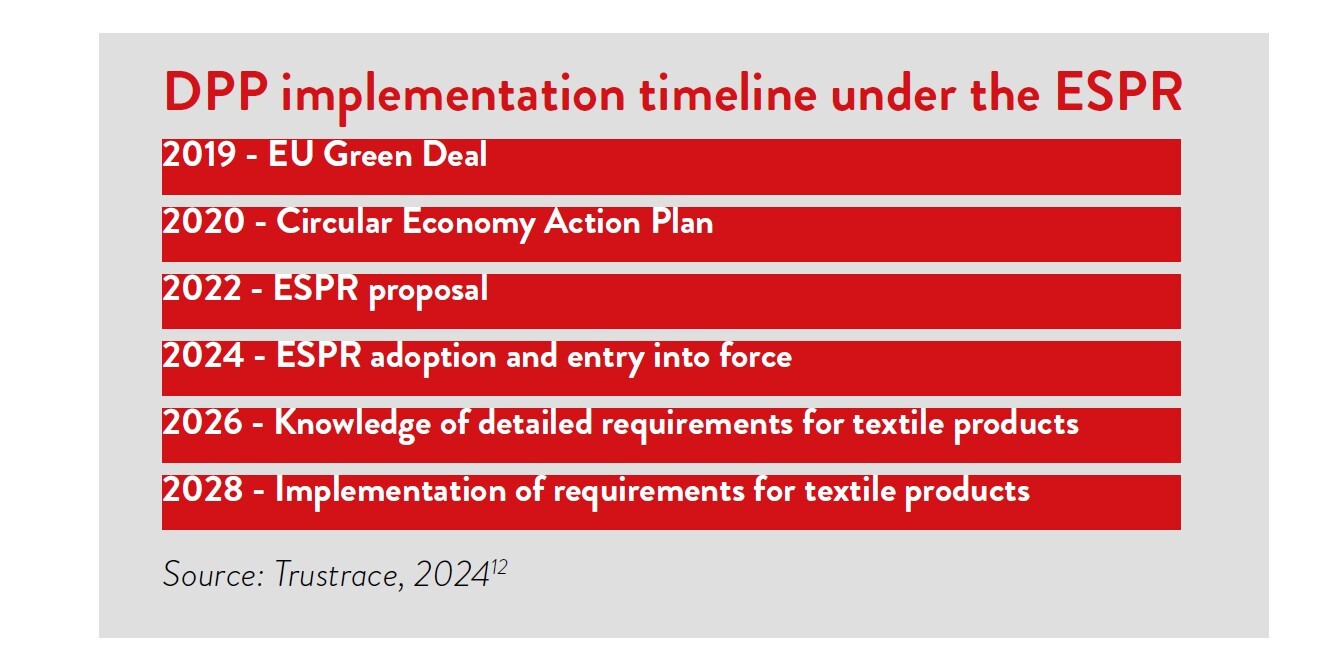
Taking ownership of the entire product lifecycle can take many forms, from a frontend and backend perspective. For higher-value products in particular, digital product passports (DPPs) are emerging as a key enabler for tracking lifecycle impacts across the value chain. It should, of course, be noted that DPPs depend on a background infrastructure of supply chain traceability tools and impact/LCA platforms. These often include supply chain management (SCM), product lifecycle management (PLM), enterprise resource planning (ERP) systems, data integration platforms, certification databases and reporting tools. Therefore, choosing the right solution is essential to ensure compatibility with not only your systems but also specific environmental impact calculation methodologies, such as the Ecobalyse platform. The data consolidation that DPPs enable can also facilitate compliance with European EPR mandates, and DPPs will also become mandatory under the recently adopted ESPR legislation from 2027.10 11
Brands need to be well aware of their regulatory exposure.
What are the routes to DPP implementation?
Competition in the DPP sphere is heating up ahead of the 2027 ESPR deadline. One company that is getting prepared ahead of the competition is eBay, which acquired Italian DPP expert Certilogo in 2023.13 The aim, according to the e-commerce site, is to provide brands with “secure, connected product solutions that are both flexible and compatible” and to help “protect their customers from counterfeits and engage in recommerce through counterfeit-proof digital product passports”.14 These are just some of the ways in which DPPs add value in fashion. Indeed, analysis by Bain & Company (in partnership with eBay, which recently bought product authentication platform Certilogo) shows that the introduction of DPPs could double the lifetime value of garments.15
Luxury brands, in particular, appear to be in the lead with regard to the opportunity this presents. The most recent Vogue Business Index reveals that the adoption rate of DPPs by the top 60 luxury brands currently stands at 67%.16 Nevertheless, luxury brands won’t be the only ones impacted by the DPP legislation. All fashion brands that put clothes (and other products) on the European market must be ready for DPP implementation by 2027. But what will be the impact of this cross-market normalisation on the differentiation potential that is currently conferred by the use of high-spec product lifecycle tracking?
Early adopter: Nobody’s Child
Nobody’s Child is a UK-based womenswear brand with a strong sustainability streak. Building on its longstanding commitment to reduce its impact on the environment, it was determined to roll out DPPs across its entire range. This required addressing the challenge of collecting 100+ data points per product and onboarding suppliers into its data ecosystem. The team’s approach was to pilot 50 styles across seven suppliers via tech partner Fabacus, using centralised data templates to streamline reporting. They performed a phased rollout by product category to manage costs, reinforcing the compliance and customer-facing transparency benefits of DPPs to facilitate internal buy-in. With good progress on the way to full range coverage, the brand has already generated substantial customer engagement through the initiative. It demonstrates clearly how supply chain transparency can support increased customer loyalty.17 18
Minimal DPP implementation or maximum circular value?
A key element of the value that DPPs bring to fashion brands is the ability to identify and track individual items, not simply SKUs. This has significant benefits from a circularity perspective, enabling streamlined repair flows and making it easier to specify the condition of individual items on re-commerce sites. Item-level data can also feed into upstream design insights, helping brands to produce more robust products in the future. However, item-level tracking is not the ‘working hypothesis’ in the industry. Instead, SKU-level tracking looks set to be the norm, at least initially. While economies of scale may be achieved for brands by this generic approach, it will increase costs at the circular operator level. This is because an additional process step – adding item-unique DPPs to each inbound garment – will be necessary. Implementing item-level tracking from the outset can therefore help to reduce friction and accelerate adoption.
The normalisation trap: What will it take to stand out?
There are two key impacts that we can expect from the widespread adoption of DPPs: first, it will be much easier for customers to investigate the sustainability credentials of a brand and even an individual product. Second, it will be much more difficult for brands to differentiate themselves based on their sustainability efforts. This may well be the catalyst that the wider industry needs to enter a ‘positive feedback cycle’, with the frontrunners raising the bar for the rest. In addition, as noted previously, mid-market brands have been on a steady premiumisation journey over the past year or so, to target more ‘aspirational’ shoppers. The certified sustainability credentials offered by DPPs may become part of the cultural cachet needed to elevate mid-market ranges even further.
Circular facilitator: Bergans of Norway
When piloting a data ecosystem with partner Trimco Group, outdoor gear brand Bergans of Norway (established 1908) took a distinctive approach: they began by prioritising making their existing circular services easily accessible. Through QR codes on garments, customers could seamlessly book repairs or access rental options in a single scan. This strategy proved particularly effective for its children’s snowsuit subscription service and Rabot collection – encouraging repeat engagement with circular offerings and driving customer retention. By removing friction from repair and rental journeys, Bergans increased uptake of circular services while building the infrastructure needed for future compliance. The pilot’s success led to the expansion of DPPs across the brand’s SS25 range, showing the value of designing your DPP strategy around user behaviour.19 20
On the other hand, standing out may not be the top priority for some brands, at least in the first instance. With an increasing array of complex requirements to meet – from Ecobalyse ratings to DPPs – simply getting products to market requires a robust and interconnected data ecosystem. Brands need to be well aware of their regulatory exposure, their system compatibility requirements and their strategy for differentiating in a market with rapidly growing sustainability maturity. We’re therefore likely to see a fundamental divide emerging: on one side, brands building their trust infrastructure as a strategic priority. On the other, companies treating regulatory compliance as a checkbox exercise, disclosing the minimum required information. In this new, highly transparent industry landscape, the difference between the two will be clearer than ever before.