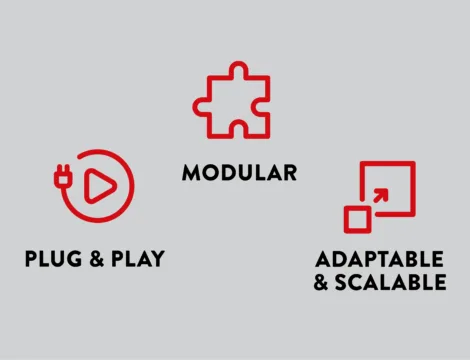









Maxim Sion is Bleckmann’s Global Sales and Business Development Manager. But he’s also a fashion entrepreneur, having co-founded the Belgian brand Studio Anvers. Now, with the launch of Bscale, Bleckmann’s new plug-and-play logistics solution, he’s ready to help more brands accelerate their growth journey with a specialist fashion logistics partner. So, why should emerging brands consider outsourcing their logistics operations?
“Keeping your logistics in-house may seem like the logical option when you’re starting out, but as your brand grows, you may start to lose out if you don’t outsource,” explains Maxim. “For example, if you’re a small team and everyone is pitching in to manage logistics, this takes valuable resources away from other important activities such as brand development. Outsourcing frees up your people to focus on what they do best.”
What’s wrong with keeping your fashion logistics in-house?
Another major disadvantage of in-house fashion logistics is the difficulty of scaling up. Indeed, as sales grow, logistics management can become exponentially more complex. At a basic level, you’ll need to commit to significant upfront costs in terms of warehouse space, personnel and tools – from scanners to a warehouse management system (WMS).
You should also reflect on whether your in-house operations can handle the volume of orders you’re experiencing, even at peak times. “Surges in demand such as Black Friday can put a particular strain on an in-house logistics set-up,” Maxim continues. “Either you need to lease extra space that you don’t use for the rest of the year, or you have to accept slower delivery times during and after the sales – neither outcome is great for the brand.”
On the other hand, by working with a specialist logistics partner with experience in handling seasonal peaks, you’ll have access to flexible capacity when you need it – not just for warehousing but also for personnel and transportation. “Working with a 3PL means you’re tapping into an established logistics network rather than trying to build your own,” says Maxim. “This can help you deliver a more consistent customer experience.”
What are the costs of keeping logistics in-house?
Keeping your logistics in-house can also pose problems in terms of cost efficiency. “Let’s say you want to employ specialist warehouse staff with an in-depth knowledge of product presentation,” says Maxim. “If you’re paying for that yourself, you’ll be paying for 100% of their time, even if you don’t have enough orders yet to justify this. By working with a fashion logistics provider, on the other hand, you’ll only pay for the support you need.”
In-house can also be less cost-effective when it comes to transportation. “Most smaller fashion brands will work with one or maybe two carriers to deliver their products,” adds Maxim. “And if your volumes aren’t that big, you’re probably being charged a pretty high rate. However, working with a dedicated fashion logistics partner often means you can benefit from preferential rates thanks to their extensive transportation networks.”
How can a 3PL help you overcome the challenges of scaling up?
While the costs of scaling up in-house logistics can be prohibitive for many brands, there’s no need to slow down your growth ambitions. By working with a third-party logistics (3PL) provider, you can overcome the challenges of scaling up without the need for significant upfront investment. To achieve streamlined growth, Maxim advises growing brands to find an apparel 3PL with dedicated fashion logistics expertise and capabilities.
“When it comes to delivering an exceptional customer experience at scale, having access to the right expertise will allow you to optimise every stage of the customer journey,” he says. “Whether it’s ironing, kitting and custom packaging for perfect product presentation or the technological integration to deliver a streamlined and transparent returns process, every element counts. Make sure you’re equipped to meet your customers’ needs.”
Unlocking new opportunities through outsourcing
A lack of specialist capabilities is another area where in-house logistics can hold your brand back. Bleckmann’s AutoStore solution, for example, enables streamlined inventory management, resulting in much faster order processing. Meanwhile, AI-driven process optimisation delivers further gains in picking and packing. And Bleckmann’s Renewal Workshop offers a range of circular solutions to reduce environmental impact. Meanwhile, the Global Bridge partnership can kick-start your international expansion.
“Developing specialist capabilities like these is often not a priority for smaller brands, but having access to them can really take your operations to the next level,” adds Maxim. “By working with a specialist fashion logistics provider, you’ll benefit from a much wider range of resources and expertise than you’d have on your own. Indeed, the right 3PL will tailor its support to your needs to help you achieve your growth ambitions.”
Want to find out more about accelerating your growth journey with Bleckmann? Visit our Bscale solution page for more information or get in touch for a free consultation with one of our experts.