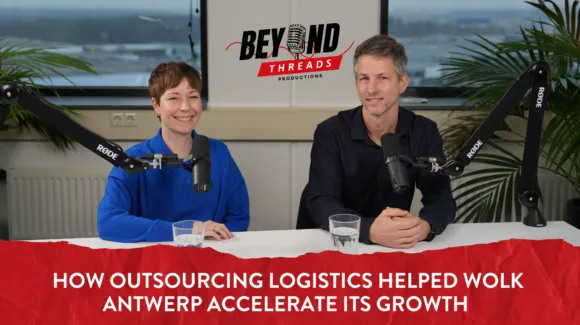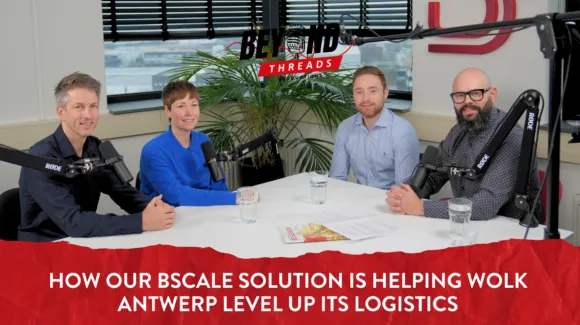









In this episode of the Beyond Threads podcast, host Erik Janssen Steenberg sits down with Sepideh Asghari, founder of Antwerp-based luxury handbag brand Sepi Agari. Together, they explore what it really takes to build a successful fashion brand from the ground up – and why a resilient mindset is just as important as creative inspiration.
Press play on the Beyond Threads podcast to get the full story!

This video is unavailable because marketing cookies have not been accepted. Click here to update your cookie preferences.
From finance to fashion: Sepideh’s entrepreneurial journey
Instead of a traditional design background, Sepideh’s previous career was in financial management for international fashion companies. This commercial perspective shaped her approach to brand-building from the outset. “I’m not a classic designer,” she says. “First and foremost, I’m an entrepreneur with a background in business.” This meant she had visibility across strategy, product development, marketing and sales – which she put to good use when she decided to quit her job and start her own handbag brand.
Listen To Audio Only
Finding the right niche: Combining luxury and accessibility
While high-fashion handbags can typically retail for tens of thousands of euros, Sepideh was on a mission to bring that same degree of quality and craftsmanship to a wider audience. This quest took her to Italy, where she learned bag-making from master artisans, studying everything from pattern-making to construction to understand what goes into a high-value product. “Our brand creates a bridge between the heritage luxury bag brands and a new generation of customers,” Sepideh continues. “They want quality, they want sustainability, they want timeless design, yet they want it to be accessible.”
True to that promise, Sepideh chose to source exclusively from Italian suppliers and haute couture ateliers – some of the same manufacturers who produce for Chanel and Louis Vuitton – using premium leather, Italian galvanised hardware, FSC-certified packaging and organic cotton linings. On the design side, collections are intentionally timeless, with considered statement pieces designed to hold their value rather than chase trends. The response from shoppers and the wider industry across Europe and beyond has validated this approach, but there have also been challenges along the way.
Overcoming obstacles on the path to global growth
Roadblocks are inevitable on the journey to building a successful brand, but Sepideh believes two factors are key when you’re facing adversity: remaining authentic to your original vision and surrounding yourself with the right team. “One-third is going to be really hard, one-third is going to be okay, and one-third is going to be good,” she continues. “You have to know yourself to know when you push and when you redirect and you pivot.” This clarity of vision is key to maintaining brand integrity as you grow.
Equally important is finding the right collaborators in all areas of the business. During the year-long process of creating her brand, Sepideh invested significant time in travelling across Italy to find the ideal suppliers. These include, for example, an 80-year-old artisan working alongside his two sons, whose atelier produces for some of the world’s most prestigious luxury houses. “He feels like every bag is a reflection of his honor for his work,” Sepideh explains. “It’s not about shortcuts, but it’s about doing things the right way.”
If you’ve been inspired by Sepideh’s story, check back soon for the next installment or get in contact for a free consultation with a Bleckmann expert to discuss your logistics needs.
Transcript
Erik Janssen Steenberg: Hi there, and welcome to another Beyond Threads podcast by Bleckmann. I’m your host, Erik Janssen Steenberg, and as always, we’re diving into the trends and developments shaping supply chain management, with a particular focus on fashion and lifestyle—the segment where Bleckmann is the expert.
For today’s topic, we’re looking at what it takes to build a brand: how an emerging company develops into a modest-sized business, then a medium-sized one, and hopefully eventually a large company.
For that purpose, I’m joined today by Sepideh Asghari, founder of the emerging brand Sepi Agari.
Thank you very much for being here today.
Sepideh Asghari: Thanks for having me, Erik. I’m glad to be here.
Erik Janssen Steenberg: I’m happy to have you, because today’s topic is something you live and breathe every day: developing a new brand.
So I’m really looking forward to our conversation.
To kick things off, can you tell me more about yourself, about the brand, and how it came to be?
Sepideh Asghari: Definitely.
I’m Sepideh, founder of Sepi Agari, a luxury handbag brand based in Antwerp. We fully source and manufacture our products in Italy.
From a young age, I was always passionate about designing. It was something I used to do in my spare time.
But I’m not a classic designer. First and foremost, I’m an entrepreneur with a background in business.
I used to work as a Group Financial Manager for international fashion brands, and throughout my career I acted as a business partner to different departments within those companies.
We’re talking about marketing, product development, design, sales, and so on.
That really gave me insight into the business and enabled me to look at a company from different perspectives, both top-down and bottom-up.
It taught me to understand the impact of strategy, the cost of making a product, the sales side, and how all those elements connect.
What really sets me apart is that I’ve combined that business expertise with craftsmanship.
I felt there was a gap in the market where craftsmanship and affordability could come together.
That’s why I decided to quit my job and go to Italy to really learn the A to Z of bag making from master artisans.
I learned everything from pattern making to actually constructing a bag, which is a very complex process.
There’s so much more to it than meets the eye.
You really need to understand what you’re doing in order to bring the product to life.
Erik Janssen Steenberg: Absolutely.
It almost sounds like you have the pedigree for this, like you were meant to be doing what you’re doing now.
From your role at your previous employer, you had already seen all sides of a successful brand.
So you knew what was needed in terms of design, manufacturing, quality control, checking and double-checking everything to make absolutely sure that the product arriving at your customer’s doorstep looks, feels, and even smells exactly the way you want it to—with that luxurious leather smell.
So you found yourself a niche.
But how did you do that?
Sometimes it feels as though you’re swimming against the current.
We’re very focused on fast fashion these days, while you are looking at luxury, sustainability, and craftsmanship.
How did you find that niche, and how are you differentiating yourself?
Sepideh Asghari: Our brand creates a bridge between heritage luxury handbag brands and a new generation of customers.
This new generation is more mindful about production processes.
They want quality, sustainability, and timeless design, but at the same time they want it to be accessible.
That’s why our customers choose us.
They don’t necessarily want to spend several months’ salary on a handbag, but they still have that mindset around quality.
From the very beginning of this journey, it was extremely important for us to create a high-value product.
We wanted customers to have that “wow” feeling when they opened the packaging and saw the bag.
So we decided to go to Italy to find the best suppliers and use the best possible materials.
And that’s something we were able to realize.
We use premium leather, Italian galvanized hardware, FSC-certified packaging, GOTS organic cotton linings, and we work with haute couture ateliers that also produce for luxury brands.
What really distinguishes the product is the touch of hand, the finishing, and the craftsmanship.
We invest heavily in finding the right suppliers and making sure everything is done to the highest possible standard, because ultimately that’s what brings a high-quality product to life.
Everything is sourced and manufactured locally in Italy.
So sustainability is very much a core pillar and a conscious choice that we’ve incorporated into every decision within the business.
At the same time, we wanted to create timeless designs.
We didn’t want to create something that simply follows a fashion trend that comes and goes.
Erik Janssen Steenberg: Understood.
Sepideh Asghari: Exactly.
We focus on timeless design throughout the collection, while also making sure there are a few statement pieces.
It’s really about bringing those different pillars together.
When I wrote my master’s dissertation, I focused on circularity and sustainability in the fashion industry.
So sustainability is something I had already been thinking about for a long time.
When I created the brand, it was important to make it a central part of what we were building.
I believe that is the future, and something most brands should be conscious of.
It isn’t always about doing more and generating more cash.
It’s also about doing things better and trying to leave a positive impact behind.
When we were deciding which partners to work with, we therefore looked for people who shared our vision and values.
Erik Janssen Steenberg: Respect for your due diligence.
It sounds like quite a lengthy process.
How long did it take you to go from the initial idea to the actual launch?
And what were some of the biggest events, surprises, or unexpected moments you experienced along the way?
Sepideh Asghari: It took about a full year to create the brand.
I would say that choosing your partners is one of the most important parts of the whole process.
It’s difficult for a young brand because you’re starting from scratch.
You really have to build everything from the ground up.
But you also have to be very selective about who you work with.
They need to share your values, and there needs to be mutual trust.
I genuinely travelled across Italy and knocked on many doors before I found the business partners I work with today.
Now I feel almost like I have a family bond with them.
One example that has always stayed with me happened when I was travelling through Italy looking for manufacturers.
I found myself at the doorstep of one of my current manufacturers.
He’s an 80-year-old Italian artisan.
Erik Janssen Steenberg: And he’s still working?
Sepideh Asghari: He’s still working.
He runs the family atelier together with his two sons.
He has been doing this his entire life.
He may not be famous to the outside world, but he’s one of the people behind the craftsmanship of major haute couture and luxury brands.
He still does it every day because it’s his passion.
He loves it, and he truly cares about his craft.
He sees every bag as a reflection of the pride he takes in his work.
Every stitch has to be right.
Everything that leaves his atelier has to be right.
It isn’t about shortcuts.
It’s about doing things properly.
When I found myself sitting at the table with him, it wasn’t just a normal business meeting.
It was a culture of involvement.
His whole family joined in.
Everyone participated.
It was lively, and there was so much passion for the craft and for creating something that was right and meaningful.
I definitely had my fair share of challenges throughout this journey.
But I strongly believe that challenges make you grow.
Erik Janssen Steenberg: And probably grow the brand as well.
Sepideh Asghari: Exactly.
In life, we tend to avoid challenging situations because they’re hard.
You’re trying to find solutions to things you’re struggling with, and often you’ve never done them before.
But you have to go through those experiences.
They shape you.
So I would say: embrace them.
Most of the time, when you look back afterwards, you realize that something difficult was actually a good thing that happened to you.
For example, when we were planning production, everything was part of a chain.
One thing had to be completed before the next step could happen.
Packaging was very important because once the bags were finished, they needed to go into their packaging as quickly as possible.
Otherwise, dust can settle on them and they need to be cleaned again.
That adds extra work and additional costs.
Everything had therefore been pre-planned.
The packaging was supposed to arrive around two weeks before the bags were finished.
But our packaging production partner is also a larger supplier that works with major brands.
So sometimes we have to be flexible.
If they receive a large order, that order may be prioritized ahead of ours.
Erik Janssen Steenberg: In fairness, that makes sense.
Sepideh Asghari: Exactly.
But in our case, the packaging ended up arriving two months later than planned.
Meanwhile, the manufacturer had a lot of finished bags sitting there.
They wanted them shipped out as soon as possible.
We also wanted them shipped because we were planning the launch event and everything around it.
So it created a major disruption in the planning.
There are so many things that are simply outside your control.
Sometimes you have to solve several problems at once.
And sometimes you have to rely on the relationships you’ve built and work together to find solutions.
But what I also learned is that afterwards, sometimes you’re actually grateful for those situations.
At first, we were extremely stressed because everything had to be postponed.
But eventually it meant we launched around January or February 2024, which is actually a strong period in the fashion calendar for accessories.
It’s almost like accessories season.
That turned out to be very positive.
When we launched, we received a lot of organic press coverage in prestigious magazines and other media, including local newspapers and publications.
That was something we never expected.
It was exciting, positive news, and it gave us a real boost.
So in the end, being late actually worked in our favor because it meant we launched during a strong accessories period in the fashion calendar and gained more traction and visibility.
Erik Janssen Steenberg: So a clear blessing in disguise.
Sepideh Asghari: Exactly.
That’s what I mean when I say that sometimes, when these things happen, you have to accept them and trust that things can fall into place.
Sometimes you have to solve a problem.
Sometimes you have to accept it.
And along the way, you learn how to navigate those situations better.
Things don’t always happen the way you imagined.
And something isn’t always simply good or bad.
It’s about navigating the situation and doing the best you can to allow things to fall into place.
Erik Janssen Steenberg: Only pressure creates diamonds.
Sepideh Asghari: Absolutely.
Erik Janssen Steenberg: Well said.
For people who want to do the same thing as you—and perhaps especially for women who want to start their own brand or their own company—it can sometimes feel overwhelming.
What advice would you give them?
Sepideh Asghari: I would say that doing this is very hard work.
From the outside, it can look glamorous because people only see the output.
But in reality, that glamorous part is maybe one percent of the whole thing.
Ninety-nine percent is execution.
So many different things are going to come at you.
You need a clear mindset and a willingness to solve problems.
But you also have to find new solutions and create opportunities.
It is going to demand a lot from you.
But if you truly want it, you’ll find a way.
You’ll put in the effort and the work.
Erik Janssen Steenberg: So when you talk about having the right mindset, you mean staying on course?
Making sure suppliers and outside circumstances don’t affect your goals or your process too much?
Sepideh Asghari: You need to do this for the right reasons.
If you’re doing it for quick money or because you think it looks glamorous, you’re going to be disappointed.
There will be a lot of challenging moments.
It’s about rolling up your sleeves and doing the work.
When I say you need a clear mindset, I also mean that you need a clear idea of what you want and what you want to put out into the world.
I strongly believe in what I call the one-third principle.
One third of what happens is going to be really bad.
One third is going to be okay.
And one third is going to be good.
If you accept that as your baseline, you’ll be fine.
If you think everything is going to be fun, you’re going to be disappointed.
You also really need to know yourself.
You need to understand when to push, when to redirect, and when to pivot.
We often hear stories about very successful entrepreneurs.
But on social media, people rarely show the full journey.
You might hear someone say that after ten years they finally made it.
But that path isn’t right for everybody.
You have to stay very close to yourself and understand when you’re making a decision based on intellect, when you’re listening to intuition, when you should pivot, and when you should go in a different direction.
Nobody else can decide that for you.
You’re the one who will be in that situation, and you have to learn what to do.
I would also recommend that everyone builds a strong team around themselves.
That doesn’t always mean hiring employees, because in the beginning that may simply not be possible.
There are so many other investments that need to go into the business.
Your team can also be family or friends.
People you trust, who know you, who can advise you, exchange ideas with you, and brainstorm with you.
I’m very grateful for my family.
They’ve been with me throughout the entire process and have helped me in many different parts of the business.
You don’t have to do everything by yourself.
Sometimes it’s extremely valuable to get ideas, inspiration, and different perspectives from the team you’ve built around yourself.
Erik Janssen Steenberg: Sparring partners.
Sepideh Asghari: Exactly.
I also think it’s important to stay in your own lane.
Don’t compare yourself too much to other people.
Don’t simply copy and paste what somebody else is doing.
Stay authentic to your own vision.
Know what you want, where you want your brand to grow, and how far you want to take it.
Be comfortable with not knowing all the answers and not being able to control everything.
Erik Janssen Steenberg: Accept that you don’t know everything.
Sepideh Asghari: Exactly.
And accept that there will be many challenges along the way.
But those challenges will make you grow.
They will teach you and strengthen you.
Once you’ve gone through those experiences, you realize you’re capable of handling much more than you thought.
In reality, you will be tested.
And it’s your passion for what you do that will push you through those moments.
I often have friends or other people tell me, “What you do looks so much fun.”
And I say: work is still work.
And behind the scenes, there is probably twice as much work as people imagine.
It doesn’t stop.
It’s not something you simply close at the end of the day and everything is fine.
You become deeply connected to what you do.
And hopefully, you care so much about it that you want to put the best of your abilities into it.
Erik Janssen Steenberg: At Bleckmann, I’m part of the sales team, but I work as a Business Development Manager.
And it’s exactly that passion you just mentioned—my love for supply chain management—that keeps me going.
I still hate falling down, but more and more I’m learning to love getting back up.
Sepideh Asghari: Exactly.
Erik Janssen Steenberg: And finding a way to navigate whatever is in front of me and keep pushing towards success.
Sepideh Asghari: Exactly.
It isn’t about how many times you fall down.
It’s about how many times you get back up.
That is what matters.
That is what defines you.
And I would genuinely say to a lot of people doing this that you will sometimes ask yourself, “Is it normal that it’s this hard? Is it normal that I’m struggling and constantly having to push?”
My answer is yes.
It is normal.
You’re not alone.
Let’s be realistic with each other.
It is very challenging and it can be harsh.
You push through it and you keep moving.
But you also need to be wise enough to pivot or change course when something simply isn’t working.
When you become deeply intertwined with your business, you can almost become one with it.
At least that was the case for me.
The brand was me, and I was the brand.
It was an extension of myself that I was trying to bring to life.
But there also needs to be some space between you and the brand, both for the health of the brand and for your own wellbeing.
That wasn’t possible for me in the beginning.
I wasn’t able to create that distance.
But it’s something you learn.
And I think it’s healthy.
A brand naturally has ups and downs.
But those ups and downs should not determine your inner emotional state all the time.
Erik Janssen Steenberg: Agreed.
Sepideh Asghari: That’s something I learned along the way.
I became better at creating that distance and telling myself: “Okay, whatever happens, this is manageable. It isn’t the end of the world. We can deal with this.”
You simply become better at managing those situations.
Erik Janssen Steenberg: I think we’re very like-minded in that respect.
So if we had to summarize it, you need to be agile, very resilient, and willing to keep pushing.
As you said, not everything is fun and not everything is glamorous.
But at least this is fun—getting you on the podcast.
Sepideh Asghari: Absolutely.
Erik Janssen Steenberg: We’ve now talked about the emerging stage of your journey.
We’ve discussed the product itself, the luxury aspect, sustainability, and everything that goes into creating the brand.
But I also want to talk about something else you mentioned: finding the right partners and building the right team around you so that the company can emerge and grow.
For that, I’d like to invite our listeners and viewers to part two.
There, we’ll discuss with Sepideh what it takes to take the finished product to market and ultimately bring it to the doorstep of the consumer.
If people would like to ask you a question, get your advice, or hear your opinion, how can they reach you?
Sepideh Asghari: We’re definitely available on Instagram. You can follow us at @sepi.agari.
You can also reach us through our webshop, www.sepiagari.com.
We’re definitely reachable through those platforms.
Erik Janssen Steenberg: Perfect.
Thank you very much to everybody for listening and watching.
I feel like this was a very important and energetic session with Sepideh, and I hope to see you again soon for part two.
Until then, see you soon.