







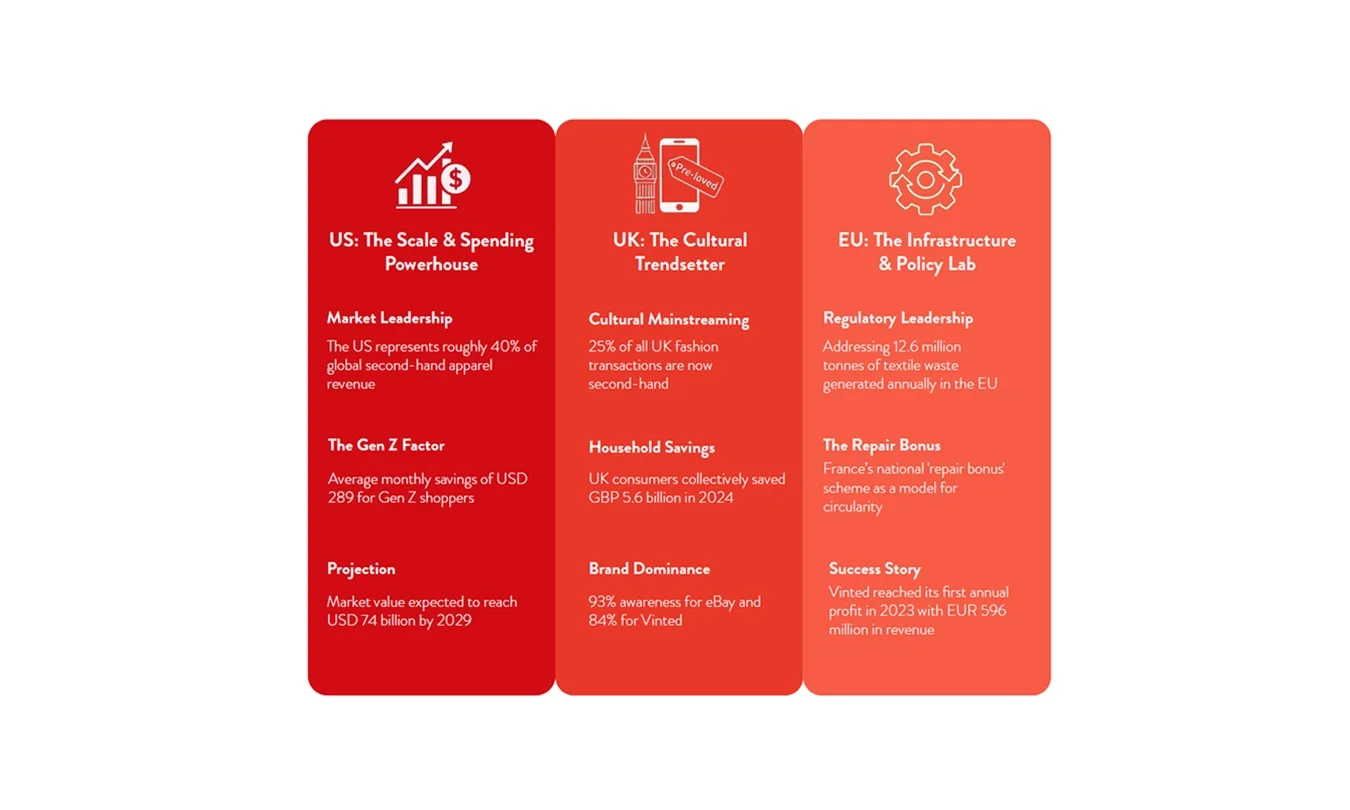
Although second-hand fashion has become a global phenomenon, the patterns of adoption and growth vary significantly across regions. The US, the UK and continental Europe together account for the majority of the global resale market, but each is evolving in its own way, shaped by local culture, consumer behaviour and policy.
United States: scale and regulatory momentum
The US is the world’s largest and most mature resale market, representing roughly 40% of global second-hand apparel revenue. Estimates suggest that the US market will expand to around USD 74 billion by 2029, with growth consistently outpacing the broader apparel sector. By this point, it’s also estimated that second-hand apparel will hold a 19.97% share in the market, up from a forecast 15.87% for 2025. In 2024, resale sales grew by 14%, five times faster than the wider clothing retail industry, and online resale surged by 23% in the same year.
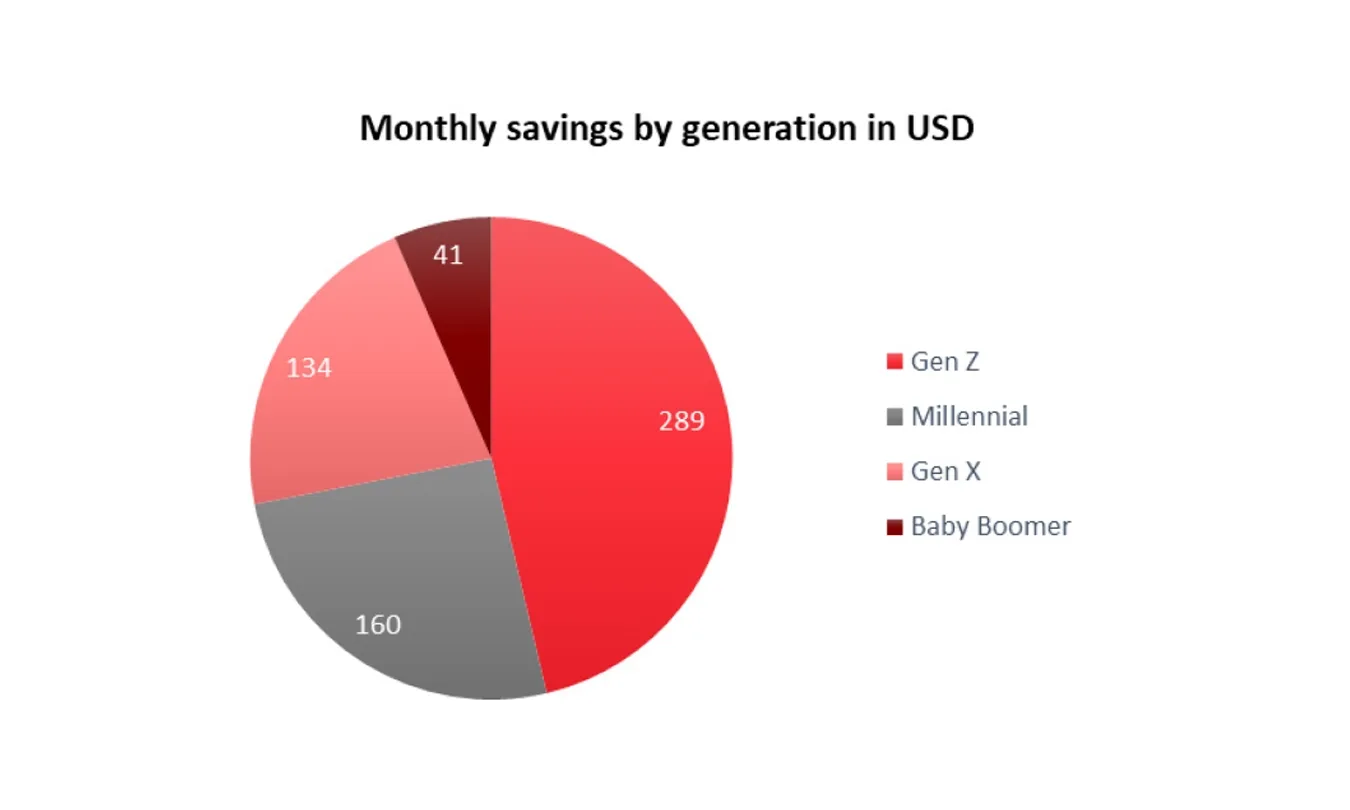
A defining feature of the US market is the breadth of participation across segments. Consumers embrace both high-volume, mass-market resale through platforms like Poshmark, ThredUp and eBay, as well as luxury consignment through specialists such as The RealReal and Fashionphile. Affordability is a primary driver, especially as households grapple with inflation and cost-of-living pressures. But sustainability and style uniqueness are increasingly important, particularly for younger shoppers. Gen Z and Millennials dominate activity: surveys show they are twice as likely as older generations to make resale their first choice when shopping for fashion and they are also more likely to save money in doing so.
Regulation is also beginning to shape the contours of the market. As previously mentioned, California’s Responsible Textile Recovery Act (SB 707) created the first EPR scheme for textiles in the US, requiring fashion companies to finance collection and recycling programmes by the end of the decade. Other states, including New York and Washington, have introduced similar bills, while Massachusetts has moved to ban most textiles from landfills altogether. These measures are laying the groundwork for resale and reuse to become embedded features of the apparel economy.
At the national level, momentum is building as well. The Government Accountability Office has called for coordinated federal action on textile waste, and new legislation such as the Americas Trade and Investment Act proposes billions in incentives for circular fashion. Industry coalitions like American Circular Textiles are also pressing for changes such as ending double taxation on second-hand goods. Together, these developments point to a future in which the US resale market is not only the largest in scale, but also one of the most regulated and structurally supported worldwide.
Affordability remains a central driver of consumer engagement. In 2025, 66% of US adults said they regularly shop second-hand, with Gen Z leading – 28% report that they thrift on a weekly basis. 72% of US consumers cited saving money as their primary reason, followed by 51% who stated it was due to the thrill of unique deals. Thrifting is increasingly viewed as an act of self-care and a cultural statement, especially among younger shoppers.
United Kingdom: cultural mainstreaming and digital acceleration
The UK has a deep-rooted culture of reuse, with charity shops long established on high streets and a vibrant vintage fashion scene. This cultural foundation has made it one of the fastest adopters of resale in Europe. Around 25% of all fashion transactions in the UK are now second-hand, and the overall resale sector is valued at more than GBP 7 billion. Forecasts suggest it will account for around 10% of total UK fashion spending by 2029, growing at about 9% per year and faster than the UK retail market as a whole.
Digital platforms have accelerated this growth, with eBay emerging as the most well-known second-hand apparel site in the UK (93% of respondents were aware of the brand), followed by Etsy (84%), Vinted (84%), ASOS Marketplace (54%) and Depop (47%), which was founded in London. London itself is a hub for preloved fashion, accounting for 25% of national second-hand apparel activity.
Affordability is a key driver of this expansion. In 2024, UK consumers collectively saved GBP 5.6 billion by buying second-hand and kept nearly 199 million items in circulation. Among younger shoppers, adoption is especially pronounced: 74% of consumers under 35 purchased second-hand in the past year, compared to just over half of those aged 55 and above. This generational gap underscores how second-hand fashion is becoming the default choice for younger demographics, who are motivated by both value and the appeal of unique vintage style.
Retailers are increasingly responding. Chains such as River Island have partnered with resale platforms to extend product lifecycles, while brands like Levi’s and Patagonia operate in-store resale and repair programmes. Policymakers are also now advancing circular infrastructure. WRAP’s ACT UK pilot, which ran between 2023 and 2025, has demonstrated that coordinated textile collection trials can increase volumes by up to 46% when households receive clear sorting instructions. It also evaluated the potential for a standalone automated textile sorting and preprocessing (ATSP) facility with the capacity to process around 25,000 tonnes of worn-out textiles annually. While only one facility model has been assessed so far, it offers a potential blueprint for scaling nationally, suggesting how future infrastructure could underpin a circular textiles system in the UK.
With high consumer acceptance and a supportive cultural backdrop, the UK market illustrates how resale can move quickly from niche to mainstream.
Continental Europe: infrastructure and policy-led innovation
Continental Europe is diverse, but the region as a whole is experiencing rapid momentum in resale. The European second-hand apparel market was valued at USD 8.36 billion in 2024 and is projected to grow at a 6.1% CAGR, reaching nearly USD 16.8 billion by 2032. This growth is being fuelled by consumer demand for sustainable fashion, the appeal of vintage and unique styles, easier access through online resale platforms, and supportive government initiatives on textile waste reduction. France and Germany stand out as leaders, while the Nordics are pioneering new approaches to circular fashion.
In France, luxury resale is particularly strong, reflecting the country’s rich high-fashion tradition and consumer appetite for premium second-hand goods. Vestiaire Collective, a Certified B Corporation and pioneer in circular fashion, now operates in over 70 countries and listed more than 5 million items in 2023, with 82% of sold pieces replacing the purchase of new items, underscoring its role as a global leader in sustainable resale. Meanwhile, France’s Anti-Waste and Circular Economy Law, adopted in 2020, made France the first country in the world to ban the destruction of unsold non-food products, requiring companies instead to reuse, donate or recycle excess inventory, linking environmental goals with social benefits by redirecting goods to charities and reuse networks.
Germany has emerged as a powerhouse for mass-market resale, underpinned by a culture that values practicality, durability and sustainability. The market is dominated by Vinted, the Lithuania-founded peer-to-peer platform that has become deeply embedded in German consumer behaviour. Vinted was the leading online second-hand clothing retailer in Germany in 2023, generating revenues of over EUR 596 million. In the same year, the platform surpassed 100 million registered users globally and posted its first profit, signalling the financial maturity of the resale model. In Germany, uptake is particularly pronounced: along with consumers in France, Poland and the UK, more than 40% of Vinted users in the country report that over half of their wardrobe is now second-hand,49 a striking indicator of how resale is being normalised in everyday fashion choices. Alongside affordability, German consumers are motivated by clear environmental benefits,50 making the country a bellwether for the potential of large-scale, mainstream resale adoption in Europe.
However, interpreting Vinted’s scale as a direct proxy for second-hand fashion requires caution. The platform has expanded beyond preworn apparel into categories such as electronics, home goods and books, and has opened its marketplace to professional sellers whose listings often include ‘new with tags’ or ‘new without tags’ items. Vinted does not publicly disclose the share of its gross merchandise value or listings that come from genuinely preworn fashion, nor the proportion attributable to new merchandise or non-fashion categories. Its 2023 Impact Report cites a 40% replacement-rate – the percentage of purchases that users say replaced buying new – but this does not equate to a breakdown of items by condition.51 These dynamics mean that while Vinted remains a central player in European resale, its topline growth figures increasingly reflect a mixed inventory spanning both second-hand and new goods, and should be interpreted accordingly.
The Nordic region is charting distinctive pathways in circular innovation, firmly integrating resale and repair into local economies. In Sweden, ReTuna Återbruksgalleria in Eskilstuna stands out as the world’s first shopping mall exclusively dedicated to second-hand and repurposed goods.52 Opened in 2015, the municipality-led initiative is part of the city’s broader climate and waste-reduction strategy. It features a drop-off point where residents deposit items, which are then sorted, refurbished and sold across the curated stores.53 As a model of design-led, ethical retail, ReTuna blends sustainable purpose with a polished consumer experience.
Meanwhile, Finland is advancing rapidly toward building its industrial-scale circular infrastructure. The city of Lahti, for example, achieved a 500% increase in textile recycling during a pilot deposit-scheme that incentivised collection with coffee vouchers and local amenity access.54 Complementing this, the FINIX project, which is funded by the Finnish government, is nurturing a national circular textile ecosystem by developing research on textile reuse, recycling and business model design.55
At a regional policy level, the Nordic Textile Re-use and Recycling Commitment – a voluntary certification system backed by the Nordic Council of Ministers – is establishing a code of conduct and quality requirements for actors involved in textile collection, sorting, reuse and recycling.56 This initiative aims to improve transparency, traceability and credibility across the Nordic circular textile sector, while supporting legitimate operators and strengthening public trust.
Together, the US, the UK and continental Europe show how second-hand fashion is evolving along different paths: scale and innovation in the US, cultural mainstreaming in the UK and infrastructure-led acceleration in continental Europe. Yet the destination is the same: resale is embedding itself as a structural part of fashion’s future. These regional variations highlight the diversity of the market and offer a preview of how other parts of the world may follow, adapting the second-hand model to their own cultural and policy landscapes.