







Due to the suspension of the de minimis provision, fashion logistics for brands importing into the US has become much more complex over the past few months. I see this change every day with clients, and one thing has become very clear: choosing the right import model can have significant long-term implications for your US-based operations.
With increased customs scrutiny of even small packages – and duties now payable on all of them – brands are asking exactly how they can best structure their logistics to balance cost, speed, customer experience and compliance requirements. Several import models are available, and understanding the strengths and limitations of each one – DDP, DAP, bonded warehousing or supply chain diversification – will help brands maintain their competitive edge while navigating the new compliance landscape.
Read on to explore the different import models available to fashion brands and discover how to make the right strategic choice for your US operations.
Choosing the right post-de minimis import model for your brand
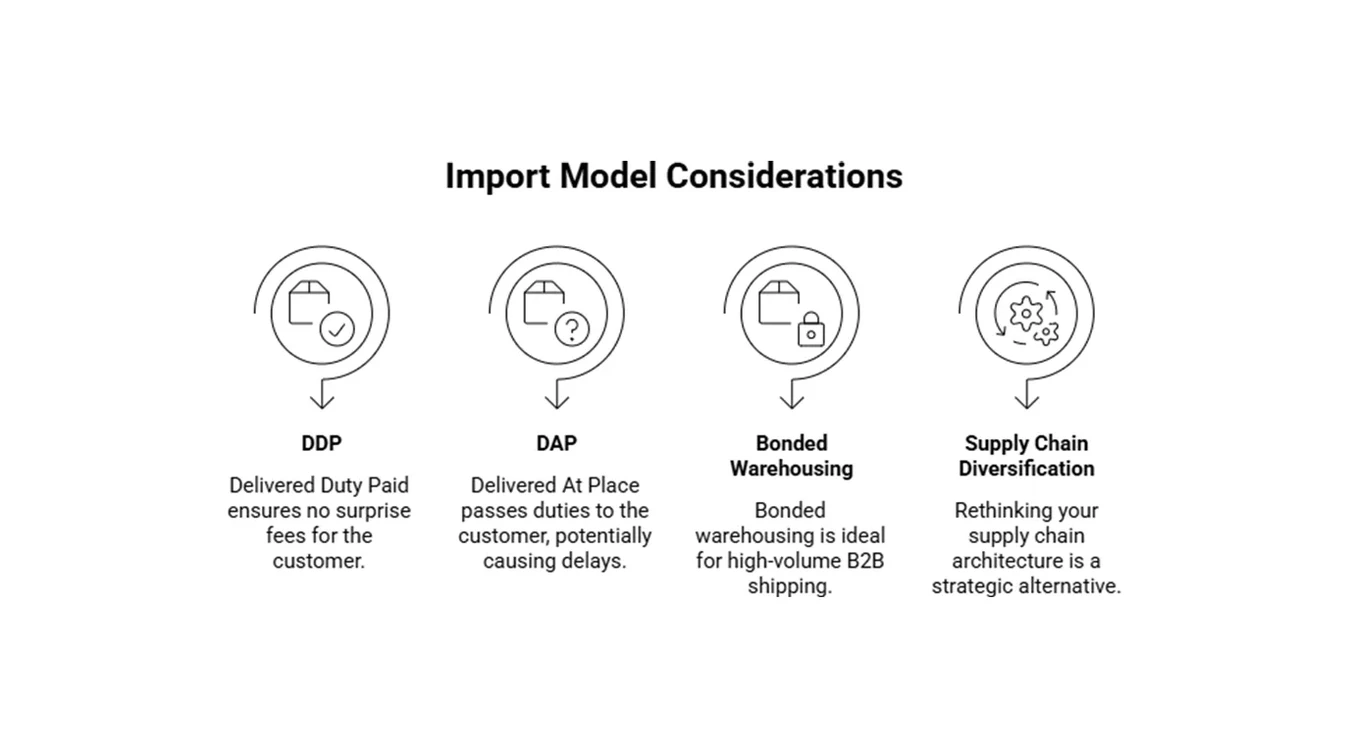
From established players to emerging brands, companies across the spectrum are reassessing their approach to US imports. Essentially, there are four main options: Delivered Duty Paid (DDP), Delivered At Place (DAP), bonded warehousing, and various nearshoring or reshoring sourcing strategies. Each option has its own distinct advantages, costs and operational requirements. So, which one is right for your brand?
DDP (Delivered Duty Paid): Seller pays all duties, taxes, and fees upfront before delivery to customer
Advantages:
Smooth customer experience
No surprise fees at delivery
Predictable pricing for customers
Higher customer satisfaction and loyalty
Disadvantages
Seller bears all customs costs
Requires upfront capital
Complex compliance management
DAP (Delivered At Place): Buyer pays duties and taxes (typically at delivery), seller handles shipping to named location
Advantages:
Lower upfront costs for seller
Reduced financial risk
Simpler compliance vs DDP
Seller controls shipping to destination
Disadvantages:
Customer pays fees at delivery
Potential for delivery refusal
Less transparent pricing
May impact customer loyalty
Bonded Warehousing: Pre-positioned inventory in US warehouse; duties paid when goods leave for final delivery
Advantages:
Faster delivery times (domestic shipping)
Duty payment deferred until sale
Better inventory positioning
Disadvantages:
Requires significant upfront inventory investment
Risk of unsold inventory
Warehouse costs and management
Less flexible for demand fluctuations
Supply chain diversification: Manufacturing relocated to countries with lower tariffs (e.g., Turkey, Morocco) or to the US itself to reduce duty costs.
Advantages:
Lower tariffs on imports to US
Reduced dependency on high-tariff regions
Improved supply chain resilience
Potentially faster shipping
Disadvantages:
Higher manufacturing costs vs Asia
Requires production restructuring
New supplier relationships needed
Significant operational change
The customer experience benefits of customs clarity
The wrong choice regarding US customs can quickly lead to customer frustration. For example, it’s been widely observed that customers will refuse to pay duties that they have been charged in addition to their purchase, principally under the DAP incoterm. This refusal can result in packages being returned, with the costs falling back on the carrier and the brand. By choosing DPP, with duties charged at checkout, you mitigate this risk.
In addition, if your brand doesn’t have an existing US entity, importing goods to the US becomes much more complex. Having a US tax ID/Employer Identification Number (EIN) significantly simplifies the process, and you must always have a defined Importer of Record (IoR). Becoming an IoR as a foreign entity entails a higher administrative burden, and keeping orders flowing requires an in-depth understanding of the requirements.
Therefore, how you handle customs compliance can be key to maintaining customer loyalty in the post-de minimis landscape. To make the right choice, you need to consider several factors. These include your brand’s size and sales volume, your business-to-consumer (B2C) and business-to-business (B2B) split and whether your company already has a US entity. This guide will help you understand the options available.
Delivered Duty Paid: Smooth customer experience, no surprise fees
Best for: Medium to large fashion brands with a strong US e-commerce presence.
DDP is emerging as the preferred import model for medium- to large-sized fashion brands with a strong e-commerce presence. Of all the Incoterms (standardised trade agreements), DDP places the greatest responsibility on the seller. Under DDP, the seller covers the ‘full landed cost’ of a package, encompassing all shipping-related costs. This includes freight rates, duties, import taxes, clearance fees and last-mile delivery.
This model offers significant advantages in terms of customer experience. In practice, DDP shipping means that your US customers simply see one price at checkout and receive their order without incurring any unexpected additional fees. This is usually far preferable to the alternative, where customers are unable to receive their orders because they’ve been held at customs awaiting the payment of additional fees.
DDP eliminates such delays by collecting duties upfront, but, of course, this comes with higher upfront costs for the seller. In addition, to make DDP work effectively, brands require sophisticated systems that can accurately calculate duties at the point of checkout. This requires real-time integration with customs databases, as well as the use of Harmonized Tariff Schedule (HTS) codes, product values, country of origin data and destination information to generate precise calculations of an order’s full landed cost. It’s also important to note that an Importer of Record is required for DPP shipments. The IoR must have either an EIN or an identification number issued by the US authorities.
This is where the expertise of an experienced third-party logistics (3PL) provider becomes invaluable. Instead of brands having to negotiate individual carrier accounts and manage duty prefinancing, 3PLs can leverage their existing carrier relationships to streamline the duty collection process. In this set-up, the carrier organizes the pre-financing of duties, then invoices the 3PL directly. This means that, even if multiple carriers are used for shipping, the brand will simply see the duty charges reflected on their monthly invoice.
Looking to learn more about DDP? Check out this article next to get the full story!
Delivered At Place: Duties passed on, but potential for delays
Best for: Smaller fashion brands with established B2B relationships in the US or brands with an existing US entity that can send goods via intercompany shipping.
The Delivered At Place (DAP) Incoterm is an alternative to Delivered Duty Paid (DDP). Under DAP, the seller delivers goods to a named destination and covers all transportation costs and risks up to this point. The buyer is responsible for import duties, taxes, customs clearance and unloading. Shipping DAP can, therefore, reduce upfront costs for the seller. This Incoterm may be attractive for smaller brands with B2B partners in the US who are familiar with handling local import procedures. Brands should nevertheless be aware that there is likely to be a delay in the delivery dates of their DAP shipments. In addition, DAP can be problematic for direct-to-consumer (D2C) orders.
One important disadvantage of shipping DAP rather than DDP for D2D orders is that goods are typically held by customs until duties are paid. If you don’t clearly inform D2C recipients that this will happen, they will be unaware that the US customs authorities will send them a demand to pay a fee to release their package. This can come as an unwelcome surprise, and many customers will simply refuse to pay. Due to the high recorded refusal rates, most carriers do not fulfil D2D packages to the US using DAP. This has a doubly negative impact: customers don’t receive their order, and you have to undertake the costly and complex process of facilitating returns across the Atlantic.
Bonded warehousing: Great for high-volume B2B shipping
Best for: Large, multinational brands able to invest in high levels of stock upfront.
For fashion brands shipping large volumes of goods to the US, bonded warehousing can improve cash flow and minimise administrative burden. In a bonded warehouse, goods imported into the US can be stored without the immediate payment of customs duties. Duties are deferred until the goods are ‘cleared into free circulation’ for their final destination. This can be particularly valuable when you’re importing goods in bulk but expecting to sell your stock over a longer time period. This model can work well for brands importing large volumes into the US from global manufacturing centres.
However, it should be noted that bonded warehousing in the US operates differently from European models. In Belgium or the Netherlands, for instance, goods in bonded storage can be repackaged, relabeled or otherwise modified. US bonded warehouses are far more restrictive: goods must remain in their original state. You cannot, for example, take an item out of its original packaging and put it in different packaging or combine it with another order in a larger package – or relabel anything – while it’s under bonded status.
Foreign Trade Zones (FTZs) present an emerging alternative to bonded warehousing. Roughly a US equivalent of international Free Trade Zones, FTZs are designated secure areas near US ports of entry where goods can be brought in without immediately paying customs duties. FTZs are more permissive when it comes to repackaging and relabeling than US bonded facilities. Understandably, FTZs come with significant administrative complexity, and few brands are using them following the suspension of de minimis.
Strategic alternatives: Rethinking your supply chain architecture
When considering the right US import model to adopt in the post-de minimis landscape, some brands are thinking more structurally about their operations. For established multinational brands with US entities, intercompany transfers can potentially deliver savings. This is achieved by shipping goods from your European entity to your US entity at cost value (rather than retail value), reducing the dutiable value of imports.
Many larger brands are also modifying their sourcing strategies. For brands whose current supply chains are largely dependent on high-tariff countries, relocation of manufacturing facilities can help to mitigate the financial impacts – optimizing duty exposure while building supply chain resilience. This trend is far from new. A 2023 survey conducted by BCG showed that more than 90% of manufacturing companies had already moved at least some of their production from China in the past five years.1
Some brands are also implementing split-at-source strategies to counter the impact of increased tariff exposure. Typically, brands based in Europe would consolidate all their stock in the EU before sending a portion on to the US. However, given that goods imported from the EU to the US now face a tariff of 15%,2 it can be more beneficial to ship directly from the country of origin to the US. This means that duties are applied to the ‘first sale’ price rather than the final price charged to the customer. The ‘first sale’ rule can only be applied when a complete ‘paper trail’ of documentation with full details of the product’s sourcing journey is provided (including purchase orders, contracts, bills of lading and evidence that the goods are destined for the US. Implementing split-at-source therefore requires sophisticated supply chain coordination and comprehensive visibility.
Adjusting your import models to the post-de minimis reality
The end of the de minims exemption has added a new layer of complexity to an already volatile and fragmented trade environment. Our role as a fashion logistics provider is to correctly situate your brand within this landscape and provide you with the tools to mitigate risk and accelerate growth. This starts early in the onboarding process, with a comprehensive information-gathering stage that allows us to understand your needs. From there, we work with you to develop a holistic solution that reduces costs across the supply chain. By optimizing for your logistics flows, you can ensure that US-based customers benefit from the same high levels of customer experience as those in Europe.
Looking for guidance on how to adapt your import models in the post-de minimis landscape? Get in contact today for a free consultation with a Bleckmann expert!
DISCLAIMER:
The information provided by Bleckmann to third parties is intended for general informational purposes only. While every effort is made to ensure the accuracy and completeness of the information, Bleckmann makes no representations or warranties of any kind, express or implied, about the reliability, suitability, or availability of the information. Bleckmann accepts no liability for any loss or damage arising from reliance on this information. Any use of the information is at the recipient’s own risk.