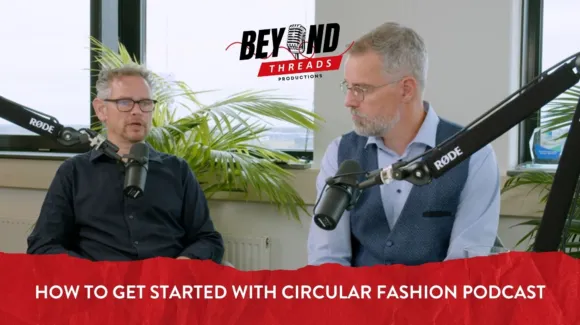









As part of the EU’s Green Deal package, textiles and apparel placed on the EU market are soon expected to come into scope for a Digital Product Passport (DPP): a digital record capturing details such as a product’s origin, the materials it’s made from and how it can be repaired or recycled at the end of its life. In this episode of the Beyond Threads podcast, host Erik Janssen Steenberg talks to Jeanet van der Stoel, Sector Lead Textile and Apparel at GS1 Netherlands, and Bleckmann Manager CSR Ron Thijssen. Together, they discuss what the DPP requires in practice, what it means for how fashion and lifestyle brands capture and manage supply chain data, and why getting started early is the key to long-term compliance.
Press play on our latest Beyond Threads podcast to hear more from the experts.

This video is unavailable because marketing cookies have not been accepted. Click here to update your cookie preferences.
Digital traceability: What does it mean for my products?
Every garment already carries a label with basic information about product composition and country of origin, but a DPP will contain more detailed, product-specific information. Depending on the applicable rules, this may include material composition, traceability data, repair instructions, and guidance for disassembly, reuse and recycling at the end of its life.
DPPs are typically accessed via QR codes based on GS1’s Digital Link standard. A single scan can connect users to product information from multiple data sources, including information about a product’s composition, sustainability credentials and end-of-life treatment instructions. Jeanet’s team has been piloting this in the field, including at a sock factory in Pakistan, where the challenge of attaching a scannable identifier to a product with no label revealed just how much practical problem-solving the rollout will involve. But in addition to these ‘frontend’ considerations, the ‘backend’ also requires attention.
Listen To Audio Only
Beyond European borders: The global supply chain data challenge
While the DPP legislation is European, many brands source raw materials or manufacture items outside Europe, meaning product data will have to be recorded and shared across complex international supply chains. The further down the supply chain you go, the harder that becomes. “Interoperability is key,” says Jeanet, noting the parallel with human communication around the world. “It would be way more efficient if we talked in one language,” she says. “The same thing applies for the textile industry. We have so many different production facilities, different tiers, the internal systems like ERP, PIM and PLM. How can we speak one language to make it much easier to collect and share the data across the systems?”
The challenge isn’t limited to manufacturing and sourcing; logistics providers like Bleckmann can also be part of a product’s digital passport. For instance, once an item passes through our Renewal Workshop for cleaning or repair, that activity gets added to the passport, helping to trace the product’s circular history through to its second life. “With the information in a standardised DPP, you know exactly what has been done to the product and what you can and cannot do with a product at the end of its life,” says Ron. “That makes it easier and more efficient for companies to start refurbishing, reusing or recycling items.”
Get prepared, get compliant: Why starting now gives you an edge
The main legislation introducing the DPP has been passed, so can brands get ready? Jeanet's advice is to begin with the data already in your systems, identify the gaps and get started by running a pilot. It’s also important to note that DPP QR codes can have value beyond just compliance: the same code can link to a product page and connect users to brand loyalty programmes and feed their curiosity about a product’s sustainability impacts – so the investment can also benefit the customer experience. Finally, as Jeanet points out, the barcode felt like a big change 50 years ago, but now it’s become a standardised tool for identifying and pricing products. She predicts that DPP QR codes will do the same.
Want to know more about the EU Green Deal legislation and its implications for fashion and lifestyle brands? Stay tuned for more episodes of the Beyond Threads podcast or get in touch for a free consultation with a Bleckmann expert.
Transcript
Erik Janssen Steenberg: Hi there, and welcome to yet another episode of the Beyond Threads podcast by Bleckmann. As always, I’m your host, Erik Janssen Steenberg, and once again we’ll be taking a deep dive into what is developing in fashion and lifestyle supply chains.
Today’s deep dive is all about sustainability legislation: what is developing, what is coming our way, and the innovation needed to comply with it.
For this purpose, I’m joined today by Jeanet van der Stoel, Sector Lead Textile & Apparel at GS1 Netherlands—which is quite a business card—and my other guest, whom you’ll already recognize, Ron Thijssen, Bleckmann’s very own CSR Manager.
I’m very happy to have you both here.
Jeanet van der Stoel: Happy to be here.
Erik Janssen Steenberg: Good. Today we’re looking at the topic of the Digital Product Passport, the DPP.
I have a lot of questions and need to learn much more about what it is all about. But let’s start by having you briefly introduce yourselves, explain your roles, and tell us why you’re at the table discussing this topic.
Jeanet van der Stoel: Thank you, Erik.
My name is Jeanet van der Stoel. I’m Sector Lead Textile & Apparel at GS1 Netherlands.
GS1 Netherlands has been active for 50 years, and GS1 gives products a universal language so that businesses can identify, track, and share information about those products anywhere in the world.
How do we do that? We are a neutral, not-for-profit organization. We work with various industries, from consumer goods through to retailers.
I work specifically with the textile and apparel industry.
Within this industry, the GTIN is one of the best-known GS1 standards. GTIN stands for Global Trade Item Number, and it is used for product identification.
We strive to provide access to reliable data for every product through a single scan, and for that we use global standards.
Erik Janssen Steenberg: I’m sure we have the right person at the table. Thank you.
Ron, how about you?
Ron Thijssen: Thank you.
As mentioned, my name is Ron. I’ve been working at Bleckmann for around 14 or 15 years, and for the past six years I’ve been leading our activities around Corporate Social Responsibility.
In short, it’s sustainability across the board.
And of course, with upcoming legislation, there are many different regulations, and one of the important developments is the Digital Product Passport.
Erik Janssen Steenberg: Then let’s immediately start the deep dive.
DPP has really become a buzzword lately. What does it stand for, and what do brands and the people listening to us need to understand about it in order to prepare for compliance?
Jeanet van der Stoel: If we talk about the Digital Product Passport for the textile industry, everybody knows the label attached to a garment.
Today, you might see information such as the product composition and where it was produced.
The Digital Product Passport contains much more information.
You will be able to scan it digitally and access information such as where the product was produced, how you should take care of it, and eventually how it can be recycled.
So it is a digital record introduced by the European Union.
It will become mandatory under the Ecodesign for Sustainable Products Regulation, the ESPR, which falls under the European Green Deal.
Erik Janssen Steenberg: And what standards does a brand need for the DPP?
Jeanet van der Stoel: From GS1, we have three important standards that can support compliance with the Digital Product Passport.
The first is the GTIN, which I mentioned in my introduction: the Global Trade Item Number.
That is the number that today you commonly find underneath a barcode, but it can also be connected to a QR code.
The QR code can be physically attached to the product label. You scan it and gain access to information about the product.
Everybody knows a QR code: you scan it, and it can link you to a product page.
But when that QR code is powered by GS1 Digital Link, it can connect to different information sources.
That means one QR code linked to a GTIN can take you to a product page, it can also be used at checkout, it can support logistics applications such as carrier information, and it can provide access to the Digital Product Passport.
Another important standard is the GLN, or Global Location Number.
This is a number that can be used throughout the supply chain.
It can identify a legal entity or a production facility.
So, simply put, the GTIN identifies a product, while the GLN can identify a location.
Erik Janssen Steenberg: It sounds a little like a product label on steroids, so to speak, for a simple consumer like me—and probably for some of our listeners as well.
I know you’ve already been working on this for quite some time and understand the full extent of the potential impact on brands and eventually on consumers.
Could you give us an insider’s view through some practical examples? What do they involve? What is required? How does it work? That way, our listeners can get a better idea of what is actually coming.
Jeanet van der Stoel: The DPP is expected to become mandatory for products covered by the legislation.
That is one of the reasons we’ve been researching how a QR code and Digital Product Passport could work on something as simple as a pair of socks.
We have several examples, but I’ll explain the sock project.
In 2024, I visited a sock factory in Pakistan.
A sock normally doesn’t contain a traditional garment label, so the question was: how do you physically add the QR code to the product?
The scope of the project was to develop a Digital Product Passport together with a local solution provider in Pakistan.
That distinction is important because it is sometimes misunderstood: GS1 is not a DPP solution provider. We are a standards organization.
One part of the pilot was therefore to understand how we could physically attach the identifier—the QR code—to the sock.
We tested several possibilities, including a sewn-in QR code, heat transfer, and a knitted QR code.
The knitted QR code and the heat-transfer version could be applied to the sock, but after rubbing and normal use, they were no longer sufficiently scannable.
So eventually, they chose a woven label.
The second part was to assign GLNs to the different production facilities.
It was a vertically integrated supply chain covering different stages such as spinning, dyeing, and manufacturing.
Each relevant location in the chain could therefore be linked to a GLN.
Finally, the Digital Product Passport was created together with the local solution provider and based on GS1 standards.
The socks were identified with a GTIN and connected through GS1 Digital Link using the QR code.
So the pilot demonstrated that a Digital Product Passport can be built and supported using GS1 standards.
Erik Janssen Steenberg: And in the end, the QR code was on the inside of the sock?
Jeanet van der Stoel: In the end, they used a woven label on the outside of the sock, so it was still visible.
And then you immediately encounter another practical question: you have two socks, a left one and a right one. How do you deal with that?
It’s just one example, but there are many situations like this throughout the industry that show how companies can already start experimenting with Digital Product Passports.
Erik Janssen Steenberg: Ron, from your perspective as something of a single source of truth within Bleckmann, why do you think high-quality, standardized data is becoming such an important mission for logistics service providers like ourselves, but also for the fashion brands themselves, especially in the omnichannel environment we operate in?
Ron Thijssen: First of all, because it is mandatory. It is regulation, and companies will have to comply with it.
That is the first point.
Second, it is all part of the Green Deal, and one of the main themes of the Green Deal is transparency.
That is exactly what the DPP is about.
It is essentially a digital manual containing information about the product itself.
As Jeanet explained, it tells you where the product comes from, where it has been, how to take care of it, how it should be handled at the end of its life, and how it can be recycled.
All of that information is necessary because we are trying to become more circular.
Brands therefore need to make that information available through the Digital Product Passport.
Where does Bleckmann come into the picture?
At the first stage, we don’t necessarily have a major role because we don’t own or manufacture the products.
However, we do have our Renewal Workshop, where we clean, repair, and refurbish items.
As soon as you become part of that process, you may also need to add information to the Digital Product Passport.
The consumer can then ultimately see where the product has been and whether it has been repaired, for example.
Erik Janssen Steenberg: So that means we do have a distinct role to play within the overall ecosystem.
Ron Thijssen: Yes.
Erik Janssen Steenberg: And this isn’t something that remains somewhere beyond the horizon, only affecting manufacturing.
It is going to happen.
What are the main challenges that companies like us—and of course our brands—can face when it comes to data accuracy across that entire collaborative system?
Ron Thijssen: You’ve already mentioned the key issue: data quality.
First, you need the data at all. Second, you need high-quality data.
This is European Union legislation, but Europe is only one part of a global supply chain.
A large proportion of the production facilities are located outside the European Union.
We therefore need to explain to those production facilities not only which data we require, but also why we require it.
And then we have to ensure the quality of that data.
That is going to be quite a challenge.
The legislation is European, but much of the practical impact takes place at the production facilities, because that is where a lot of the information has to be collected.
Jeanet van der Stoel: I often use the word interoperability.
Interoperability means that we use one common language that can be understood across different systems.
Think about all the different spoken languages in the world. Communication would be much more efficient if everybody could use one common language.
The same principle applies to the textile industry.
You have many different production facilities and different tiers within the supply chain.
At the same time, a company may have its own internal systems such as ERP, PIM, or PLM systems.
Then you need to obtain data from your supply-chain partners.
The question is: how do we make all those systems speak the same language so that it becomes much easier to collect and share data?
Erik Janssen Steenberg: When you were in Pakistan and working in other countries, did you see interest from the manufacturing side? Were they eager to understand why we are asking for this information?
Because ultimately, if they cannot provide the information needed for DPP requirements, that can create serious problems for them as well.
Jeanet van der Stoel: It depends on the tier within the supply chain.
In tier one and tier two, companies often already have quite a lot of data available.
It also depends on the size and maturity of the company.
But as you move further down the supply chain, collecting the data can become more difficult.
That is why we need harmonized systems that allow data to be shared in the same way.
We also see this challenge around certifications.
Manufacturers may have to comply with many different certifications and requirements.
So there are still many steps for the industry to take.
Erik Janssen Steenberg: What do you think is the right time for brands and manufacturers to start looking into the DPP?
Of course, you’re going to say today, because there’s no day like today.
But is there also a competitive advantage for brands that start early? And is there a certain preparation period before you can actually become compliant?
Jeanet van der Stoel: It’s a good question.
The delegated acts are not all in place yet, but the textile industry knows that this is coming.
So the question is: how can brands already get started, and where might they gain a competitive advantage?
It all starts with collecting data and looking into your own systems.
What data do you already have?
We’ve developed a five-step guideline for getting started with the Digital Product Passport.
The first step is simply understanding where to begin.
For example, a GS1-powered QR code using Digital Link can eventually be used for the Digital Product Passport, but it can also be used at checkout and for things such as loyalty programs.
So there are applications beyond compliance alone.
Erik Janssen Steenberg: So you also see opportunities in it.
Jeanet van der Stoel: Definitely.
Then you need to ask: who is part of your Digital Product Passport team?
You need to identify what data is already available in your systems and what additional data still has to be collected.
Then you need to decide what kind of system you want to work with.
Do you want to build a Digital Product Passport yourself, or do you want to work with a solution provider?
After that, you start with a pilot, like the sock example I mentioned.
But ultimately, it is all about scalability.
How do you scale the Digital Product Passport across all the garments within your organization?
Erik Janssen Steenberg: When you look at the growing regulatory pressure, but also the interest among brands in becoming as sustainable as possible and the growing demand from consumers for sustainable products, do global standards help companies remain compliant without sacrificing too much agility and competitiveness?
Jeanet van der Stoel: Definitely.
Standards improve efficiency throughout the supply chain, but they can also help build trust with consumers.
A good example is the barcode.
Around 50 years ago, the barcode was introduced in the Netherlands after it had already been seen in use in the United States.
Now, 50 years later, around 40,000 companies use GS1 standards.
The power lies in standardization.
That standardization creates efficiency.
And that is one of the reasons GS1 is so powerful.
We are a worldwide organization, and our role is to support the industry from a neutral perspective.
Erik Janssen Steenberg: Ron, is that in line with your view, especially when it comes to standardization?
Ron Thijssen: Yes.
If you move further downstream towards the end of the product’s life, you really want to know what you can still do with that item.
With the information in a Digital Product Passport, presented in a standardized language, you can understand exactly what can and cannot be done with the product at the end of its life.
That makes it easier and more efficient for companies to refurbish, reuse, or recycle products.
So it is absolutely a game changer.
Erik Janssen Steenberg: Looking ahead, what advice would you give our listeners to motivate them to get started?
They need to rethink operational models. They need to start thinking about data and how they capture it.
What would you say to motivate them?
Ron Thijssen: First of all, you have to do it.
It is mandated, so there is no way around it.
That is point one.
Second, as Jeanet mentioned, you may currently only have a limited set of data.
Use that as your starting point.
Start with the limited data you have today and expand from there.
If you are an early starter, you can also benefit from consumer curiosity.
Consumers are curious about products.
They may start scanning products because they want to know more about them.
If the information is standardized, consumers can make better-informed decisions about whether or not they want to buy something, because they have access to the information they need.
Erik Janssen Steenberg: And that is likely to trigger more interest in the overall product and the brand as well.
Ron Thijssen: Exactly.
Jeanet van der Stoel: I completely agree.
You cannot jump into something new without first getting the basics right.
So start with your data today.
The Digital Product Passport legislation is coming.
It will be there.
The question is: how ready is your organization to start?
For me, the first step would be to look at your internal data, start with a pilot, and then scale it up.
Erik Janssen Steenberg: It isn’t going to be perfect from the start.
Jeanet van der Stoel: No. It cannot be.
Erik Janssen Steenberg: And if you need or expect it to be perfect from the very beginning, you’re probably never going to start.
Those are excellent pointers.
I really think we’ve helped our listeners—and definitely yours truly—to understand the DPP much better and what it will take to implement it successfully.
Unfortunately, that is already all the time we have for today’s podcast.
So let me thank you both very much for your input and for being here today.
We now know quite a bit more about DPP, but the discussion will probably also have triggered a desire for more information and perhaps further conversations with you.
Jeanet, how can people reach you if they want more information or would like to discuss working on a solution?
Jeanet van der Stoel: You can find more information on our website, gs1.nl.
You can also find me on LinkedIn. My name is Jeanet van der Stoel.
Erik Janssen Steenberg: Thank you.
Ron, same question for you.
Ron Thijssen: People can reach me through our website, bleckmann.com.
Go to the sustainability section and you’ll find my contact details there.
Just send me an email with your question.
Erik Janssen Steenberg: Great. Thank you both.
Without a doubt, your inboxes are going to be busy.
And to our audience, listeners, and viewers: thank you very much for tuning in today.
Like me, you’ve hopefully learned a lot about the Digital Product Passport and everything it entails for brands, consumers, and for us as logistics and service providers.
Make sure you subscribe to our channels and follow us on social media so you can stay on top of everything that is developing in fashion and lifestyle logistics.
And make sure you tune in again for our next podcast.
Until then, my name is Erik Janssen Steenberg. See you soon.