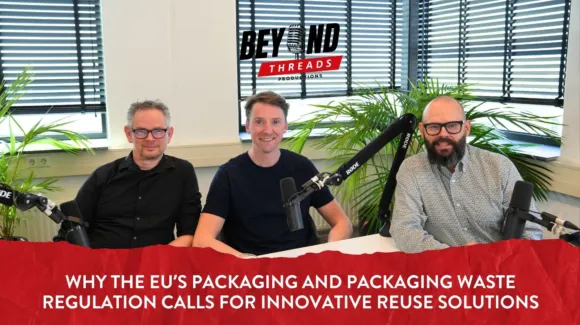






One of the core elements of the EU’s Green Deal legislation package is a fundamental rethink of how every business in Europe handles waste. In this episode of the Beyond Threads podcast, host Erik Janssen Steenberg talks to Stijn Smetsers, CCO of circular waste management platform Seenons, and Bleckmann’s Manager CSR, Ron Thijssen. Together, they discuss the Waste Framework Directive (WFD) – a key element of the Green Deal specifically targeting the environmental impacts of waste – and what an effective operational response looks like for fashion and lifestyle brands.
Press play on the Beyond Threads podcast to get the full story.

This video is unavailable because marketing cookies have not been accepted. Click here to update your cookie preferences.
Waste no more: What’s the compliance burden for brands?
The WFD sets a hierarchy for how waste must be treated, from prevention at the top, through reuse, repair and recycling, with incineration and landfill at the bottom. The requirements make this a Directive that brands can’t ignore: by 2030, all packaging must be recyclable, and there are targets for recycled content and packaging composition.
The complication for brands operating across multiple markets is that each EU member state must transpose the Directive into its own national rules. That’s 27 countries, with 27 sets of rules – and within those, multiple regional variations. There’s no question that this will place a considerable administrative and operational burden on fashion and lifestyle brands. So, what’s the key to achieving compliance?
Listent To Audio Only
Transparently better: Why data is the compliance imperative
Traceability is necessary for compliance with the rules, and it requires focused efforts. Seenons works with Bleckmann in the Benelux region to collect granular, standardised waste data that can withstand scrutiny from local authorities and feed into CSRD reporting. “Data is the new gold,” says Stijn. “If you take responsibility as a producer or as a logistics company, you have to show it. What is the traceability of that type of material? Show me that it has been recycled. How are you going to show that with data?”
The ongoing collaboration with Bleckmann and Seenons has demonstrated the gains that are possible through this joined-up approach, giving more transparency to both our own teams and clients’ sustainability functions. “Alone, you cannot do it,” Stijn continues. “You need designers, you need waste and recycling infrastructure, you need people handling it in between – everybody should be aligned.” Starting with a pilot across four sites in the Netherlands and Belgium, we’ve built a shared policy, a data infrastructure and a proven waste management process that achieves a high recycling rate. The model has now been rolled out more widely, and we’re excited to continue improving.
The operational advantages of being an early mover
The brands that treat the WFD as a distant compliance deadline are the ones that will find themselves with the least room to manoeuvre. Building the infrastructure to both meet the regulatory obligations and manage reporting takes time, and brands that start now will be the ones best placed to turn compliance into capability. That’s where the right partnerships make the difference. As Ron puts it: “You need a partner, a specialist who is really deep into the matter. Start from what you have, and then add the data, or improve the data, or whatever is needed to get to the goal. It’s going to be a journey.”
Want to know more about the EU Green Deal legislation and its implications for fashion and lifestyle brands? Stay tuned for more Green Deal podcasts soon, or get in contact for a free consultation with a Bleckmann expert!
Transcript
Erik Janssen Steenberg: Hi there, and welcome to the Beyond Threads podcast by Bleckmann. I’m your host, Erik Janssen Steenberg, and as we do in every episode, we’re going to take a deep dive into what is changing, what is developing, and the trends shaping fashion and lifestyle logistics.
In this episode, we’ll take that same deep dive, but this time into sustainability legislation and the innovations that can help us in logistics—and you as brands—become as sustainable as possible.
For this purpose, I’m joined today by Stijn Smetsers, CCO of Seenons, and our very own Ron Thijssen. You’ve met him before; he’s our CSR Manager at Bleckmann. I’m very happy to have you both here.
Stijn Smetsers: Thanks for having me. I’m looking forward to the podcast.
Ron Thijssen: Absolutely. Thank you, Erik. Great to be back.
Erik Janssen Steenberg: Today, with this deep dive, we want to learn more about the WFD, or the Waste Framework Directive. I really need your help with this one because you work with it on a daily basis. For me, it’s still something of a buzzword, and potentially for the people listening to our podcast as well.
So after you briefly introduce yourselves, I’d like to get down to business as quickly as possible. Stijn, please introduce yourself and explain how you became so deeply involved in the world of recycling and waste management, and of course your role at Seenons.
Stijn Smetsers: Thanks, Erik. I’ve now been active in logistics and recycling for 23 years. In recycling, I started by working for a paper and cardboard collector in Belgium, and that’s where I really learned how the recycling industry works.
Then, in 2019, I decided things needed to be done differently, and I founded a company called Recycling Partners Belgium. The idea was to help large organizations make their waste management more efficient and, importantly, more sustainable, acting as an independent waste broker.
In 2023, we decided to join forces with the Seenons Group. Since then, I’ve been commercially responsible for the Seenons Group in Europe, focusing on international customers and international expansion, while maintaining that core objective of creating more sustainable waste management for our customers.
Erik Janssen Steenberg: How did you come to the conclusion that the processes or outcomes needed to change? Why did you decide to start your own company? Was it because of changing legislation?
Stijn Smetsers: At the time, everybody was saying, “We want to become more circular. We want to have less waste.” But in my view, the traditional waste industry was organized around generating more waste, because more waste meant more revenue for traditional waste companies.
I always say that when we look at waste management, we used to start at the back door. You put a container there, the customer fills it, it gets picked up, and then it gets processed.
But the process actually starts much earlier. It starts at the front door.
If you want to improve waste management at the back end of your building, you first need to look at what is coming in and how it is coming in. If something enters my supply chain, what am I going to do with it? How am I going to sort it? How am I going to dispose of it? With whom? Where is it going? And how can I maintain an overview of all of this when I’m operating across 10 or 15 locations, for example?
You need an orchestrator, and that’s the role I saw. We took that role and developed a much more hands-on, solution-driven, and holistic approach.
You need to start thinking earlier about how to prevent a tonne of waste from being created in the first place, because the best tonne of waste is always the tonne that doesn’t exist: no cost, no impact.
Erik Janssen Steenberg: Definitely. Ron, you’re doing quite similar work at Bleckmann. Even though you’ve introduced yourself to us several times before, would you nevertheless do us the honor?
Ron Thijssen: Absolutely. Thank you very much. My name is Ron Thijssen. I’ve been working with Bleckmann for almost 15 years, and for the past six years I’ve been responsible for leading the company’s Corporate Social Responsibility activities.
So it’s all about sustainability. And we had the same questions Stijn had a couple of years ago about our waste management: how do we reduce waste?
That’s quite a challenge. Goods arrive in boxes, and boxes come in and go out. It’s a very straightforward business in that sense, and we cannot simply eliminate the amount of waste. That’s another chapter.
But we do want to become more efficient and more cost-effective. Communication needed to improve, and there had to be a clear reporting structure.
We didn’t just want to measure it and create KPIs. We also knew that CSRD reporting was coming and that waste would have to be reported. That’s where our journey to find the right partner started.
Erik Janssen Steenberg: An additional factor, of course, is that the party bringing in the waste—or at least the packaging material that ultimately becomes waste—is our customer. So in that sense, it isn’t really our waste; it’s our customers’ waste.
You’ve already started touching on why this partnership exists, but could you explain what the partnership between Seenons and Bleckmann entails and what it brings to both of our companies?
Stijn Smetsers: I’ll give it a go. We first got in contact around 2020 or 2021.
At the time, Bleckmann had around 25 sites, and we saw that there wasn’t really a central overview of what was happening with the waste.
It was a very complex setup. Every site had a different supplier and different solutions. There was no single policy.
So we decided this needed to change if we wanted to achieve certain sustainability and CSR goals, including Ron’s objectives.
We started by carrying out scans on the operational floor. What are we doing today? What types of materials are present? How are they treated? How are they sorted? What infrastructure is currently available? Which suppliers are you working with?
It was a major exercise. We then analyzed all that data and established ambitious KPIs.
Ron Thijssen: You need to be ambitious.
Stijn Smetsers: Exactly. Start small, but remain ambitious.
We initially started with four sites in the Netherlands and two in Belgium.
Ron Thijssen: The bar was set quite high. We set the recycling rate target at 90% and wanted to see where we would end up and whether it was achievable at all.
Stijn Smetsers: The pilot went well. We didn’t achieve those results from day one, of course, but we could see a clear pathway towards the goals we had set.
At that time, we were still operating under the name Recycling Partners Belgium together with our Dutch partner, RCN. We joined forces to create a Benelux approach.
Since then, both RPB and RCN have become part of the Seenons Group. Today, as Seenons, we serve Bleckmann at Benelux level, and we’re even discussing possibilities to expand the collaboration into the UK and Spain so that we can create the same advantages there.
One approach, one predictable outcome.
Erik Janssen Steenberg: For the viewers and listeners—and unfortunately, I also have to admit for myself—could you explain what the EU Waste Framework Directive is really about?
You live and breathe this every day, but it would be beneficial for the rest of us to understand what we are actually talking about.
Stijn Smetsers: Without going into every detail, the Waste Framework Directive really sets the standard for how companies—and in fact everybody—should treat waste.
It creates a hierarchy for waste treatment. In Dutch, we know the Ladder van Lansink, and you also have the R-ladder. It establishes a hierarchy for how waste should be handled.
It begins with prevention. As I said, the best tonne of waste is the tonne that doesn’t exist.
From there, you move through options such as refusing, repairing, reusing and recycling. At the bottom of the hierarchy, you have incineration, incineration with energy recovery, and landfill.
Those final options are the ones we want to avoid as much as possible because that’s where much of the emissions impact comes from.
Ron Thijssen: The Waste Framework Directive is part of the broader EU Green Deal.
Europe intends to become more circular—or, put another way, Europe has decided that we have to become more circular—and aims to become the first zero-emission continent by 2050.
Part of achieving that is becoming more circular, and one way of becoming more circular is reducing waste.
But that doesn’t happen automatically. Guidance is needed, as well as rules, directives and regulations. You need to establish a level playing field and create rules that companies and consumers have to follow in order to ultimately achieve that goal.
Stijn Smetsers: Exactly. And the Waste Framework Directive then becomes the basis for other regulations that follow from it, such as Extended Producer Responsibility, or EPR, and the Packaging and Packaging Waste Regulation, PPWR.
There are a lot of acronyms.
Ultimately, however, the question is: how do we move towards a circular economy? Whose responsibility is it? How should products be designed? What type of packaging should be used for a particular material? And how do we report everything back to governments, both locally and internationally, so that they understand how we are performing today?
Ron Thijssen: The impact on our clients is huge because if you want to recycle something, you cannot start thinking about it at the end.
You have to start at the beginning.
You need to design a product so that it can be recycled, reused or otherwise kept in circulation. It starts at the design phase, and that’s why the impact on our clients is so significant.
Stijn Smetsers: It has an impact on the entire chain. As Ron says, it starts with how you design the product, how you package it, and which materials you use.
In the end, those materials can become your waste.
If you want to keep that waste as high as possible on the R-ladder—for example through repair or reuse—those choices are extremely important.
The question becomes: how can we make it recyclable?
Ron Thijssen: Exactly. If you look at Extended Producer Responsibility, EPR, in the old days it was quite simple: you produced something, you sold it, and that was the end of the story.
Now, you produce it and sell it, but you remain responsible until the end of the product’s life.
So you really have to think the product through. It’s no longer simply a matter of producing it, selling it and then throwing it away.
Stijn Smetsers: For the Packaging and Packaging Waste Regulation specifically, it starts applying in August 2026, so this is a very relevant topic right now.
For certain types of packaging, making the transition is relatively simple. For others, it is much more difficult, particularly when you have multilayer materials and similar combinations. That is something we want to move away from.
Going towards 2030 and beyond, the requirements become increasingly strict and packaging needs to become recyclable.
The European legislation is already there, but each country still has to implement and enforce the requirements. Initially, some obligations concern larger companies and specific situations, and then the scope broadens to include smaller and medium-sized enterprises and more types of packaging.
Ultimately, everything needs to move towards recycling at scale.
Ron Thijssen: And that’s where things become quite complicated.
The European Union issues requirements that the individual countries then translate into national regulations.
The complicating factor is that every country can have different regulations while working towards the same European objective.
So you have 27 countries and potentially many different sets of rules. If you’re a company selling in 27 countries, you can end up having to comply with many different requirements.
Stijn Smetsers: That’s also one of the areas where we try to make a difference.
We currently manage waste in more than 20 countries, with specialists in each country—or even in individual regions.
Belgium is a good example. It’s a relatively small country, but it has three regions, which can have different rules regarding how waste should be sorted at source.
Ron Thijssen: Flanders, Wallonia and Brussels.
Stijn Smetsers: Exactly. So even within one country, you already have several sets of rules.
If you go to Switzerland, you can encounter requirements at canton level. In Germany, you can have differences between the Bundesländer.
There are a great many regulations you need to comply with.
And that brings us to something that is absolutely crucial in this entire story: data.
You need the data that local authorities require. You need to demonstrate traceability.
If you take responsibility as a producer or as a logistics company, you have to be able to show what happened to a particular type of material.
Show me that it was recycled. How are you going to demonstrate that?
With data.
People often say that data is the new gold, and in this case it really is becoming increasingly important.
But you need to be capable of collecting that data.
We still see a lot of assumptions being made in the market. This is where we help customers by collecting granular and normalized data so that they can report as realistically as possible to whoever requires that information.
At the same time, that data gives them insights they can actually use to manage and improve their operations.
Ron Thijssen: Ultimately, several things are happening at the same time.
First, you have your own goals. We want to be a sustainable company, and we have established a KPI for our recycling rate.
But ultimately, all of this also feeds into the larger Corporate Sustainability Reporting Directive, CSRD.
As a company, we have reporting obligations, and waste, waste management and waste data form part of that reporting.
So we really need to make sure that all of the necessary data is available for future reporting.
Erik Janssen Steenberg: Although you’re explaining this in a very informative way, I’m pretty sure that some of our listeners are starting to break out in a sweat, because this is quite a lot that is coming their way.
With all due respect, it is quite far removed from their actual core activities: creating a beautiful product or service, marketing, sales and building a brand.
And then suddenly they are confronted with legislation that can have a major impact on their teams and operations.
What other challenges are you currently seeing for brands and companies trying to become more knowledgeable and prepared for these directives?
Ron Thijssen: Logistics in Europe is cross-border, but legislation is defined by borders. That’s where it becomes complicated.
I completely understand why companies might break out in a sweat.
The best thing you can do is start with what you already have.
Look at the legislation. What do I need, and what do I already have?
Don’t try to make everything perfect from the very beginning. Start with what you have, and then add data, improve the data, or make whatever adjustments are required to reach the goal.
It is going to be a journey.
Sometimes it will be difficult, but you have to start somewhere.
Even if you begin with smaller steps, as long as those steps move in the right direction towards the Waste Framework Directive and towards circularity, take them.
Ask your suppliers. Ask your logistics partner: what data do I need? How can you help me?
We are all in this together. You cannot do it alone.
It’s a supply chain. It consists of multiple elements, and there is nobody in that supply chain who can achieve this alone. You really need each other.
Erik Janssen Steenberg: That was actually going to be my follow-up question. Is it even possible for a brand to do all of this entirely by itself?
Stijn Smetsers: I completely agree with Ron. It really is about collaboration and partnerships, because you cannot do it alone.
You need designers. You need waste and recycling infrastructure. You need people handling the products and materials in between.
There are a lot of hands that products pass through, and everybody needs to be aligned.
It’s also about awareness and human behavior.
It sounds easy when you say it, but the details are in the execution.
This is a process we have to go through to move from a linear model towards a circular model. Collaboration is absolutely key, and so is transparency.
Sometimes people invent a solution but keep it to themselves. Ultimately, everybody should be able to benefit from successful solutions. Of course, I understand that there needs to be a financial model behind that as well.
But it is going to change companies’ business models. It is going to be a burden. That’s simply the reality.
And that’s also part of the role Seenons takes.
We see ourselves as an additional colleague sitting next to Ron, or next to whoever is responsible for waste management within a company.
Waste management is almost never that company’s core business, but it is our core business.
It’s our responsibility to make sure customers receive a hassle-free service, that they make an impact, that they save costs—because that remains important—and that throughout the journey they remain compliant with all the regulations in every region where they operate.
Those are essentially the four areas we work on together with Bleckmann and with our other customers, primarily in production, logistics and retail.
Erik Janssen Steenberg: I predict that this level of support and taking the burden away from companies will definitely be in high demand once all of this really kicks in.
Ron, earlier you said that the best thing brands can do is simply start.
Don’t wait until your processes or your entire approach are 100% designed, implemented and ready to go. Simply start and ease into it.
Do you have other practical examples of steps brands can take to get started?
Ron Thijssen: First of all, look at your own processes. That’s the obvious starting point.
Sometimes the solution can be very simple.
Why not reuse boxes for your outbound shipments?
Use the same boxes the goods arrived in for outbound shipments. That already reduces your waste.
Look at the materials you are using.
At each individual step, take a close look and see where and how you can improve.
Stijn Smetsers: Another area we have focused on is looking at what is currently going into residual waste and identifying what we can remove from that stream and preserve as a raw material.
You can start very small.
Sometimes it may simply be one type of plastic that you separate. We then make sure it goes to recycling rather than being lost as a raw material.
You can also think about initiatives related to the ban on the destruction of goods.
For example, together with your customers, ask: if we have overproduction or materials left over, instead of destroying them, what else can we do?
Is there a second-hand market? Are there other channels we can use?
Ron Thijssen: Exactly.
You have your full retail-price sales. If a product doesn’t sell at full retail price, you may have an end-of-season sale.
Then you have returns in e-commerce or through the B2B channel.
The next question is: how can we save those returns?
Can we clean them? Can we repair them? Can we give them a second life?
At Bleckmann, for example, we have the Renewal Workshop, where we can help our clients put those goods back onto the market for a second or third life.
At the end of the process, instead of simply throwing something away, shredding it or otherwise destroying it, the objective is to bring it back into circulation.
Erik Janssen Steenberg: And for the listeners and viewers, that new rule means that you can no longer simply destroy your products.
Where it may once have been almost common practice to dispose of products, going forward that will increasingly no longer be an option.
You therefore need to start thinking about a second, third or even fourth life for your product before you produce it—during the design stage.
That’s why we at Bleckmann, and Seenons as well, are constantly thinking about “what if?”
Take returns, for example. We have our own returns processes.
A very large proportion of returned products can be restored to A-grade quality so that they can be sold again.
If that isn’t possible, B-grade products can potentially be sold through other channels or in other regions.
Only after exhausting those possibilities do you start thinking about recycling and repurposing the materials contained in those products.
Simply putting products into the flames is no longer an option.
How does our partnership put us ahead of this directive?
I think the main message of this podcast to brands and companies out there is: reach out to us and let’s team up.
But how exactly will that benefit brands? Why shouldn’t they simply figure everything out themselves?
Stijn Smetsers: There are a lot of common practices and lessons that can be shared.
We talked earlier about the pilot at the initial sites. That was an important learning experience.
Across those sites, we identified all kinds of challenges related to sorting, residual waste that still contained recyclable materials, missing data and other issues.
But what we learned was relatively easy to expand to the other Bleckmann sites.
You can create a central policy and define how you want to work.
Every location still has its own characteristics because the types of materials and customers can differ, but 80 to 90% of the approach can often be copied.
Erik Janssen Steenberg: So it becomes a strong, proven process and a proven tool, so to speak.
Stijn Smetsers: Exactly.
And when you then work with other logistics providers or producers—whether in fashion, food or another industry—you often see overlap and knowledge that can be transferred.
That includes how to organize processes, how to collect your data, and understanding what recycling infrastructure is available in a particular region or country.
You need that knowledge to make sure a particular material is genuinely recovered and given the best possible purpose.
Ron Thijssen: And as we said earlier, waste is not our core business.
Waste is not the core business of our clients either, and they simply cannot know everything about it.
You need a partner and a specialist who is deeply involved in this subject.
If we have a question about waste, cardboard, batteries or anything else coming from an operation—or if we have questions about legislation or data—with Seenons we have a partner who is just a phone call away.
We can say: “Stijn, help us out. We or our client have a specific question about waste in Belgium, France or another country.”
And when I say Stijn, of course, I mean the entire Seenons team. Stijn is simply our main point of contact.
Erik Janssen Steenberg: I normally shy away from scare tactics, but brands and companies: please start.
Reach out. Start thinking about this directive and the requirements that are coming your way, because they are going to demand a lot from you as a brand.
By working together, we can take some of that burden away from one another and create strong alliances that turn this into part of day-to-day business instead of an insurmountable mountain.
Unfortunately, even though I could continue talking with you for much longer because I’d really like to get into the details, that’s all the time we have for this podcast.
I think we’ve given our listeners a very good idea of why we teamed up, what our goals are, and the benefits of working together towards a shared objective.
Without a doubt, many questions will come from brands. Some of them will be for you, Stijn, and some will be for you, Ron.
Stijn, how can people reach out to you or your team and get down to the dirty business, so to speak?
Stijn Smetsers: Good waste is dirty waste.
Of course, you can reach out through our website, www.seenons.com, and fill out the contact form.
You can also find me on LinkedIn.
We’re happy to help, happy to connect, and happy to see what we can do.
Erik Janssen Steenberg: Thank you.
And even though the entire Bleckmann team is of course available for questions and invitations to work together, Ron is our point person.
Ron, how can people contact you if they want to discuss this further?
Ron Thijssen: The same way. Go to www.bleckmann.com, open the sustainability section, and you’ll find my details and contact information there.
Erik Janssen Steenberg: Good. Thank you both very much for joining us today.
Don’t forget to subscribe if you want to stay on top of everything that is developing and all the trends in fashion and lifestyle logistics.
Follow us on our social channels, and make sure you tune in for the next podcast.
Until then, my name is Erik Janssen Steenberg. See you soon.